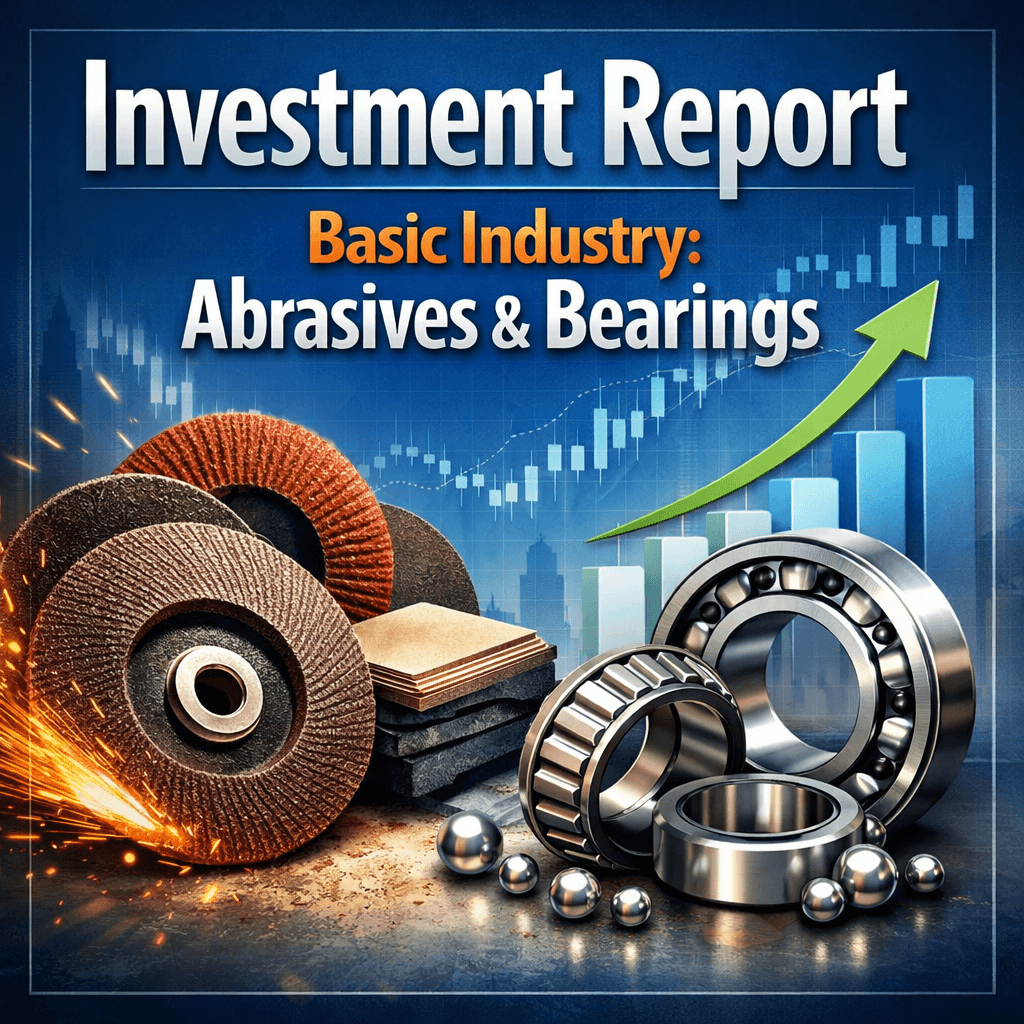
Investment Report: Basic Industry - Abrasives & Bearings
A Top-Down Fundamental Analysis from Macro-Economy to Micro-Industry
Welcome, investors and market students. Today, we are looking at the unsung heroes of the manufacturing world. Without abrasives, nothing can be accurately cut, ground, or shaped. Without bearings, no machine, EV, or wind turbine can move without destroying itself through friction. Let's dive into the fundamentals.
1. Macro-Economic Sector: Industrials
Definition: The Industrials macro-sector represents the physical backbone of the global economy. It encompasses all companies involved in manufacturing, building, producing, and distributing physical goods, including aerospace, defense, machinery, and construction.
Key Insights:
India's Alpha: India's industrial sector is growing at nearly double the global rate due to heavy government capex and supply chain diversification away from China.
Capacity Utilization: Indian manufacturing capacity utilization is hovering around the critical 75% mark, which historically triggers explosive private capital expenditure (Capex) cycles.
Explanation:
Think of the Industrials sector as the "engine room" of the economy. When the economy is doing well, factories run at full capacity, roads are built, and goods are transported. If a country wants to become an economic superpower, this sector MUST grow.
2. Sector: Capital Goods
Definition: Capital Goods are the "machines that make other machines." This sector includes companies that manufacture heavy machinery, electrical equipment, and engineering tools sold to other businesses (B2B) rather than consumers.
Key Insights:
Multiplier Effect: Every ₹1 invested in capital goods creates a multiplier effect of ₹3-₹4 across the broader economy.
Import Substitution: India has historically imported high-end capital goods. Government policies (like the Capital Goods Scheme Phase II) are fiercely driving domestic manufacturing.
Explanation:
If a bakery wants to sell bread (consumer good), it first needs to buy a giant commercial oven. That oven is a "Capital Good." This sector thrives when businesses are optimistic and willing to invest heavily in expanding their factories.
3. Basic Industry: Abrasives & Bearings
Definition: Abrasives are extremely hard materials used to cut, grind, polish, and shape other materials (like metal or glass). Bearings are mechanical components that reduce friction between moving parts, allowing rotational movement with minimal energy loss. They are the ultimate consumable products of the industrial world.
Key Insights:
Consumable Nature: Abrasives wear out and need constant replacement. Bearings suffer wear and tear. This creates a beautiful, recurring revenue model for companies.
The EV Shift: Electric Vehicles require fewer bearings than internal combustion engines (ICE), but they require highly specialized, silent, low-friction bearings that command massive premium margins.
Explanation:
Bearings and Abrasives are the "toothbrush and toothpaste" of the manufacturing world. Just like you have to buy toothpaste repeatedly, factories have to constantly buy grinding wheels and replacement bearings. This gives these companies incredibly stable cash flows.
4. Leading Global Companies in Abrasives & Bearings
Key Insights:
Oligopoly Market: The global bearing market is highly consolidated, controlled by a few massive European, American, and Japanese players (like NSK and NTN).
Margin Leaders: American firms like 3M and Timken generally command higher operating margins due to deep R&D moats and aerospace/defense applications.
Explanation:
The global leaders in this space are century-old giants. Making a bearing that can withstand the extreme heat of an airplane engine or the pressure of a wind turbine takes decades of metallurgical research. The moat (barrier to entry) is immense.
5. Leading Indian Companies (Listed & Unlisted)
Key Insights:
MNC Dominance: The Indian market is heavily dominated by the listed subsidiaries of global MNCs (SKF, Timken, Schaeffler, Grindwell/Saint-Gobain).
CUMI's Unique Position: Murugappa Group's Carborundum Universal is the primary homegrown Indian giant that successfully competes globally against these MNCs.
Explanation:
Foreign companies dominate India's bearing and abrasive markets because they bring superior global technology. However, since they list their Indian subsidiaries on the stock exchange, retail investors can still profit from their technological dominance.
6. Indian Listed Peers: Market Cap & Sales Overview
(Focusing on the specific peer group provided)
Key Insights:
Valuation Premium: MNCs like SKF, Timken, and Grindwell trade at very high Price-to-Sales (P/S) multiples compared to pure domestic industrial players, reflecting strong corporate governance and high return ratios.
Niche Moats: WENDT India has tiny sales but commands a ₹2,700 Cr market cap because it operates in a highly specialized, ultra-high-margin "Super Abrasives" niche.
Explanation:
Market Cap tells us the "price tag" of the whole company, while Sales tells us how much business they do. When a company's Market Cap is 8x to 10x its Sales (like Grindwell), the stock market is saying "We believe this company's future profits are incredibly safe and will grow fast."
The Classification Decoded: Why Categories Matter
Schaeffler India (Auto Components & Equipments): While Schaeffler is a global leader in bearings (FAG and INA brands), its Indian operations have evolved significantly. A massive portion of its revenue comes from high-precision engine components, transmission systems, and clutches. Since these are sold directly to OEMs (Original Equipment Manufacturers) like Maruti or Tata Motors, exchanges classify it as an Auto Ancillary player.
7. Indian Listed Peers: Growth Analysis & Future Logics
Key Insights:
The Railway Catalyst: Bearings are critical for trains. With India allocating billions to upgrade freight corridors and passenger trains, Timken is a primary beneficiary.
Export Opportunity: Carborundum Universal (CUMI) is capitalizing on the "China+1" strategy, as global manufacturers seek non-Chinese suppliers for raw minerals and abrasives.
Explanation:
Looking at past growth is like looking in the rearview mirror; it’s helpful, but you drive by looking forward. The "Core Logic" tells us the actual real-world story—like building more trains or electric vehicles—that will put money into these companies' bank accounts over the next five years.
8. Indian Listed Peers: Core Financials & [Dynamic Industry KPIs]
Industry Specific KPIs for Abrasives & Bearings:
Asset Turnover (x): Measures how efficiently a company uses its factories and machinery to generate sales. Because this is a heavy-manufacturing sector, a higher ratio means better factory efficiency.
Working Capital Days: Measures how long it takes to convert inventory and receivables back into cash. In B2B capital goods, managing working capital is the difference between survival and bankruptcy.
Key Insights:
Efficiency Kings: SKF India has a phenomenal Asset Turnover of 3.8x, meaning for every ₹1 of factory assets, they generate ₹3.8 in sales.
The Working Capital Trap: Notice how NIBL struggles. Their money is locked up in inventory and unpaid bills for over 150 days, crippling their Return on Capital (ROCE).
Explanation:
Asset turnover is like a restaurant table. The faster you serve a customer and flip the table for the next one, the more money you make from the same square footage. Working capital days represent how fast the customer actually pays the bill. SKF and Grindwell are masters at flipping tables and collecting cash instantly.
9. Indian Listed Peers: Solvency & Liquidity
Key Insights:
Zero Debt Moats: The top MNCs (SKF, Grindwell, Timken) and Wendt operate with virtually zero debt. This gives them immense pricing power and protection against high interest rates.
CUMI's Strategic Debt: Carborundum carries a tiny bit of debt, entirely strategic, largely utilized for acquiring global raw material assets to secure its supply chain.
Explanation:
Debt to Equity is how much money the company owes the bank versus its own money. Interest Coverage is how easily their profits can pay the interest bill. A ratio over 5 is great. The leaders in this industry have ratios over 100, meaning their balance sheets are effectively bulletproof.
10. Final Verdict: Best Company for the Long-Term
The Undisputed Winner: Grindwell Norton (GRINDWELL)
While SKF and Timken are phenomenal, Grindwell Norton stands out as the ultimate long-term compounding machine in the abrasive and specialized materials space. Supported by its parent, Saint-Gobain, it is an unparalleled wealth creator.
Impenetrable Moat: Through Saint-Gobain, Grindwell has access to cutting-edge ceramic, plastic, and abrasive R&D that local competitors simply cannot replicate.
Flawless Financials: It operates with zero debt, consistently commands Operating Margins near 20%, and generates incredible Free Cash Flow.
Diversification: Unlike pure bearing companies heavily reliant on the auto sector, Grindwell's abrasives and performance plastics cater to life sciences, aerospace, construction, and electronics, protecting it from auto-cycle downturns.
The Aggressive Runner-Up: Timken India (TIMKEN)
For investors willing to accept slightly higher valuation volatility for explosive growth narratives, Timken India is the premier aggressive bet. As the Indian government modernizes its railway infrastructure (freight corridors, Vande Bharat trains, and metro rails), Timken holds a near-monopoly on the high-end engineered bearings required for these heavy-duty rolling stocks. Their expanding manufacturing footprint in India positions them as a massive export hub to the rest of the world.
Why Schaeffler India looks stronger (but not in the above list):
Growth Momentum: Schaeffler is currently benefiting from a "Capex Cycle" payoff. Their recent 26-27% surge in quarterly sales and a 36% profit boost (reported Feb 2026) show they are capturing more market share in the industrial and export segments.
Financial Health: With zero debt and superior ROCE (Return on Capital Employed) compared to Grindwell, they offer a more efficient "wealth-building" engine.
But yes, they come in Auto Components & Equipment.
So while Investing, if we invest in both the companies Schaeffler and Grindwell Norton is not a good idea. Can invest in either Schaeffler or Grindwell Norton to take the benefit of this segment.
Industry Dashboard:
This report is for educational and informational purposes only. It is designed to explain fundamental analysis, industry trends, and wealth-building strategies. The content herein does not constitute a "buy," "sell," or "hold" recommendation for any security.