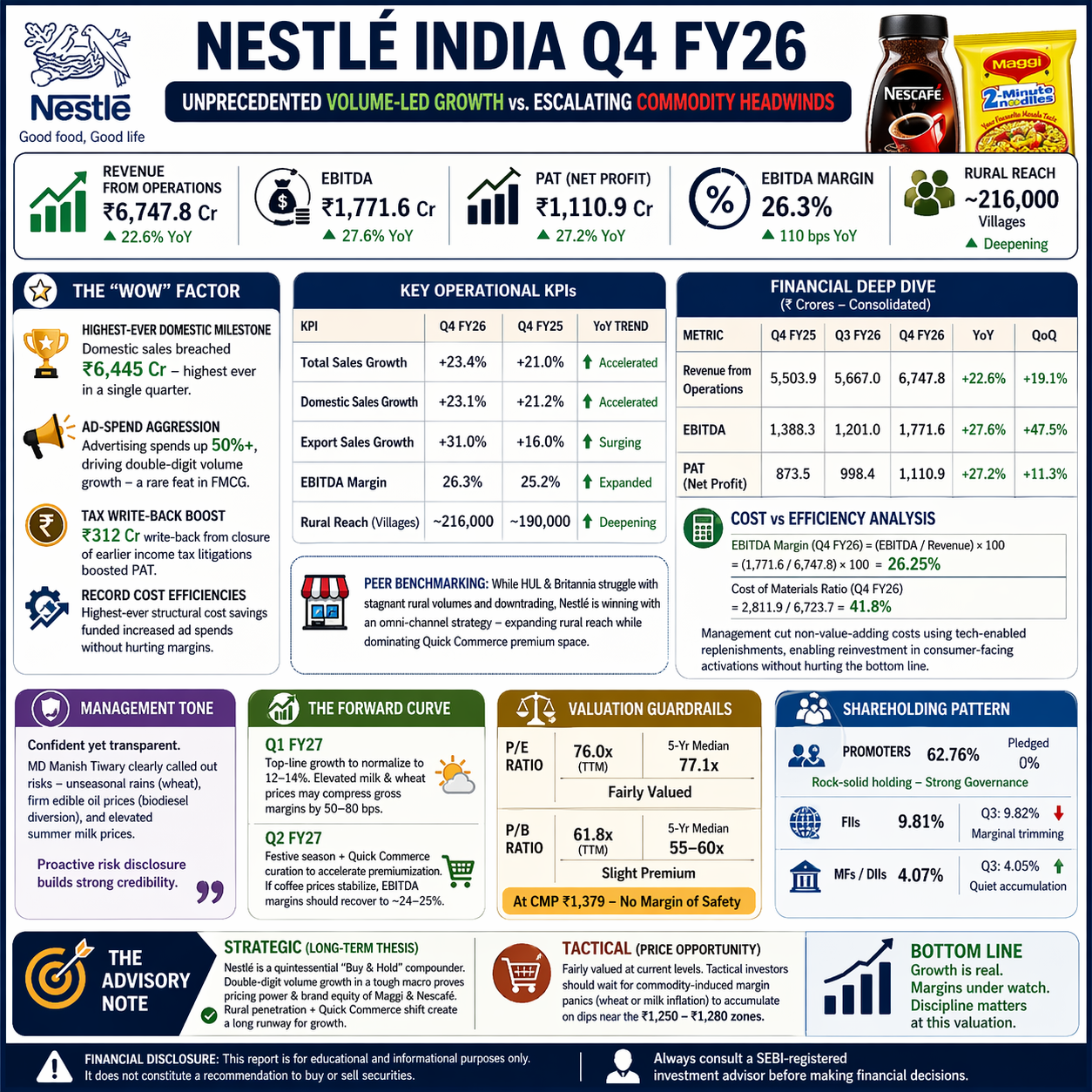
Nestlé India Q4 FY26 Analysis: Unprecedented Volume-Led Growth vs. Escalating Commodity Headwinds
Welcome back to our quarterly earnings breakdown. Today, we put Nestlé India’s Q4 FY26 (Quarter ending March 31, 2026) under the microscope. In a consumption landscape plagued by rural distress and margin pressures, Nestlé has managed to pull off a spectacular volume-led performance.
As always, we’ll cut through the noise, analyze the consolidated data, and apply our strict margin of safety guardrails to see if the underlying fundamentals justify the premium valuation.
The Snapshot
The 'Wow' Factor
Management delivered several positive shocks this quarter. Here are the data points that immediately caught our attention:
Highest-Ever Domestic Milestone: Domestic sales breached the ₹6,445 Cr mark, the highest ever recorded in a single quarter by the company.
Ad-Spend Aggression: The company ramped up advertising spends by over 50%, successfully translating marketing dollars into double-digit volume growth—a rarity in the current FMCG environment.
Tax Write-back Tailwind: A ₹312 Cr write-back from the closure of earlier income tax litigations notably bolstered the bottom line.
Record Cost Efficiencies: The company unlocked its highest-ever structural cost savings, funding the increased ad-spends without cannibalizing operating margins.
Operational KPI Table
To benchmark Nestlé's ground-level efficiency, we look at core FMCG sector metrics:
Peer Benchmarking: While closest competitors like HUL and Britannia have struggled with stagnant rural volumes and downtrading, Nestlé has successfully executed an omni-channel strategy—expanding rural reach to 216,000 villages while simultaneously dominating the Quick Commerce premium space.
Financial Deep Dive
(Note: All figures are in ₹ Crores, based on Consolidated Financials)
Cost vs. Efficiency Analysis
The math behind the margin resilience is fascinating. We calculate the EBITDA margin as:
$$EBITDA\ Margin = \left( \frac{EBITDA}{Revenue\ from\ Operations} \right) \times 100$$
For Q4 FY26, the margin stands at an impressive 26.25%, up from 25.22% a year ago.
How did they achieve this despite a 50% spike in advertising? The answer lies in their Structural Cost-Efficiency Agenda. Cost of materials consumed as a percentage of sales was strictly managed:
$$Cost\ of\ Materials\ Ratio\ (Q4\ FY26) = \frac{2,811.9}{6,723.7} \approx 41.8\%$$
Management has ruthlessly cut non-value-adding costs using tech-enabled replenishments, allowing them to reinvest in consumer-facing activations without hurting the bottom line. However, we maintain a cautious stance on raw materials.
Management Integrity and Tone
The transcript and press release reveal a tone that is confident yet transparent. Managing Director Manish Tiwary was transparent about macroeconomic headwinds, clearly identifying unseasonal rains (affecting wheat), firm edible oil prices (driven by biodiesel diversion), and elevated summer milk prices as explicit risks. This proactive disclosure of red flags builds strong management credibility.
The Forward Curve
Based on management guidance and commodity tracking, here is our projection for the next two quarters:
Q1 FY27: Expect top-line growth to normalize to the 12-14% range. Elevated milk and wheat prices during the summer months will likely compress gross margins slightly by 50-80 bps.
Q2 FY27: A strong festive season lineup, combined with aggressive Quick Commerce curation, should accelerate premiumization. If coffee prices in Vietnam and Brazil stabilize as guided, EBITDA margins should recover back to the ~24-25% baseline.
Valuation Guardrails
Where does the stock stand on the valuation matrix? Let's consult the historical median guardrails.
P/E Ratio: At the CMP of ₹1,379, Nestlé is trading at a TTM P/E of ~76.0x. When compared to its 5-year median P/E of 77.1x, the stock is currently Fairly Valued.
P/B Ratio: Trading at a P/B of ~61.8x vs. a historical median of ~55-60x, showing a slight premium based on book value.
Shareholding Pattern Dynamics: * Promoters: Holding remains rock-solid at 62.76% with absolutely zero pledged shares—a green flag for governance.
Institutional Activity: FIIs marginally trimmed their stakes from 9.82% to 9.81%, while Mutual Funds/DIIs quietly accumulated, pushing their holding from 4.05% to 4.07%. This indicates strong domestic conviction acting as a shock absorber against foreign outflows.
The Advisory Note
Strategic (Long-Term Thesis): Nestlé remains a quintessential "Buy & Hold" compounder. Their ability to drive double-digit volume growth in a challenging macro environment proves the immense pricing power and brand equity of Maggi and Nescafé. The structural shift toward Quick Commerce and rural penetration sets up a long runway for growth.
Tactical (Price Opportunity): While currently fairly valued, the stock does not offer a deep Margin of Safety for value investors at ₹1,379. Tactical investors should wait for commodity-induced margin panics (specifically around wheat or milk inflation) to accumulate the stock on dips near the ₹1,250 - ₹1,280 zones.
Financial Disclosure: This report is for educational and informational purposes only. It does not constitute a recommendation to buy or sell securities. Always consult a SEBI-registered investment advisor before making financial decisions.