Listen to this Blog
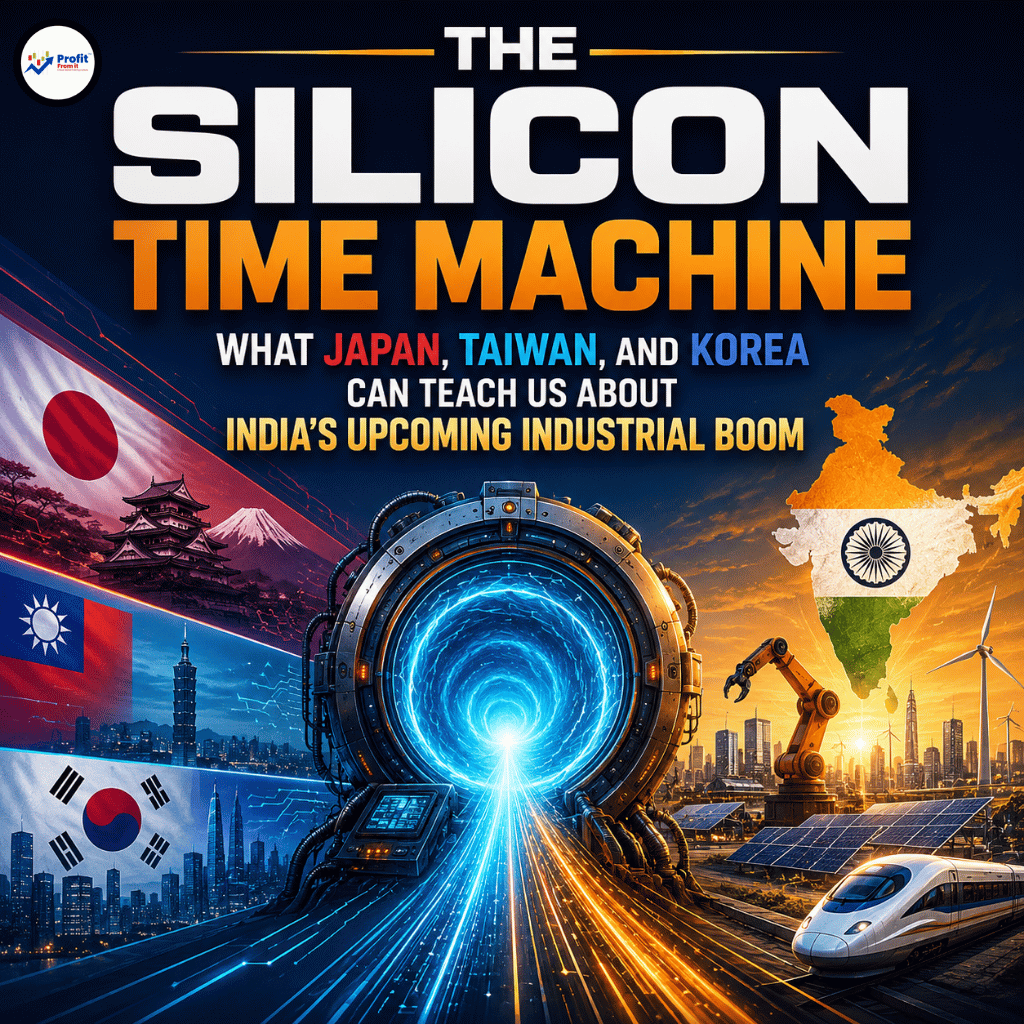
The Silicon Time Machine: What Japan, Taiwan, and Korea Can Teach Us About India's Upcoming Industrial Boom
Executive Summary
Created for: Indian Retail Investors, Wealth Advisors, Financial Educators, and Portfolio Strategists seeking structural growth opportunities.
Description: A comprehensive, multi-country investment analysis comparing US Tech, East Asian Semiconductor giants, and India’s unique domestic Capex-led growth. Learn how the Nifty 50 is building a diversified, highly resilient economic fortress to navigate the shift to 2035.
Primary Coverage: Global Economic Shift 2035, India Capex Cycle, Nifty 50 vs US Tech, Semi-conductor Supply Chain India, Capital Goods Investing India, PPP GDP Long Term Investing, World Top 10 Companies Market Cap.
Secondary Coverage: TSMC CoWoS packaging, HBM Memory Hynix, Make in India manufacturing, PLI Schemes, Indian stock market training, multi-polar asset allocation, fundamental analysis lessons.
Introduction: The Great Economic Rewiring
The global investment playbook is undergoing a structural transformation. For nearly three decades, the wealth-building narrative was straightforward: buy capital-light US software services, back Western consumption, and view emerging markets like India as mere "back-office support" or simple digital services exporters.
That playbook is now obsolete.
As we head deeper into the second half of this decade, the physical and digital worlds are colliding. Artificial Intelligence requires massive physical power grids, modern defense systems require real-time edge computing, and global corporations require supply chains insulated from geopolitical friction. This is shifting the global engine of compounding economic growth decisively toward the East.
[Old Economic Order (1995-2020)] [New Multi-Polar Order (2026-2035)]
+------------------------------------+ +---------------------------------------+
| - Western Consumed Software | | - Physical Infrastructure & Power |
| - Highly Concentrated Tech Nodes | ==> | - Diversified Local Supply Chains |
| - Single-Engine Services Export | | - Multi-Sector Industrial Production |
+------------------------------------+ +---------------------------------------+
To preserve and compound wealth over the next decade, investors cannot rely on yesterday's stock market models. We must analyze where structural capacity is actually being constructed, which nations hold structural monopolies, and why India's unique, highly diversified economy is quietly building one of the most resilient growth stories in modern economic history.
1. The Global Earnings Scorecard (Q1 2026 / Q4 FY26)
To understand the macro-dynamics of the future, we must look at the audited realities of the present. Corporate earnings from early 2026 show a massive divide. On one hand, US tech giants are extracting high profit margins on the back of generative AI. On the other, East Asian physical hardware hubs are witnessing an unprecedented explosion in revenues, while India is anchoring its corporate earnings in robust internal demand.
Below is the comparative global index scorecard for early 2026:
Key Insights for the Indian Investor:
The Semiconductor Infrastructure Tax: The stellar earnings of Taiwan ($+40.0\%$ profit growth) and South Korea ($+33.0\%$ profit growth) reveal a crucial truth. US tech giants might build the software, but they cannot run it without the physical hardware engineered in East Asia. In South Korea, chipmaker SK Hynix recorded exceptional operating margins on its advanced $\text{HBM}$ packaging, while Samsung Electronics posted a $+487\%$ net profit surge to $\text{KRW }47.10\text{ T}$ because of rising memory contract prices.
India’s Domestic Anchor: Notice that while global markets are highly vulnerable to localized cycles (Germany to energy, Taiwan to AI hardware, China to real estate), India's Nifty 50 sits at a balanced $+10.2\%$ sales and $+16.04\%$ profit growth. This is not a bubble fueled by a single temporary trend; it is a structural, domestic-led expansion.
2. The Titans of Global Capital: The World's Top 10 Companies (Mid-2026)
To understand how global capital prizes different business models, we must look at the micro-level. Market capitalization represents the aggregate dollar value that the global investing public assigns to a company's future cash flows.
Comparing Market Cap directly with Sales (Revenue) and Net Profit is a fantastic way to know the difference between high-volume businesses and high-margin intellectual monopolies.
Here is the global Top 10 scorecard as of mid-2026:
Three Critical Fundamental Lessons for Investors:
Lesson A: The Margin of a Monopoly ($\text{NPM} > 40\%$)
Observe the Net Profit Margins ($\text{NPM}$) of NVIDIA ($52.17\%$) and TSMC ($41.46\%$). Typically, manufacturing and hardware heavy sectors struggle to cross a $10\%$--$15\%$ profit margin because they have to constantly invest in physical factories, raw silicon, chemical gases, and inventory maintenance.
The fact that these hardware giants are maintaining software-like profit margins demonstrates their absolute structural monopolies in the global AI ecosystem.
Lesson B: The Volume Game vs. The Scalability Game
Compare Amazon and Microsoft:
Amazon is a revenue monster, generating nearly $2.3\times$ the sales of Microsoft ($\$595\text{ B}$ vs. $\$255\text{ B}$).
However, Microsoft generates $2.4\times$ the net profit of Amazon ($\$91\text{ B}$ vs. $\$38\text{ B}$).
Because software can be replicated instantly at near-zero marginal cost, Microsoft commands a higher market valuation ($\$3.15\text{ T}$) than Amazon’s physical logistics network ($\$1.95\text{ T}$). In other words, the stock market rewards capital efficiency and scalable intellectual property far more than raw top-line turnover.
Lesson C: The Valuation of Innovation vs. Commodities
Saudi Aramco remains one of the most profitable companies on Earth, bringing in a massive $\$115.0\text{ B}$ in clean net income—significantly more than NVIDIA and Microsoft combined.
Yet, the stock market values Saudi Aramco's $\$115\text{ B}$ in profit at $\$1.80\text{ T}$, while valuing Apple's $\$97\text{ B}$ in profit at $\$3.20\text{ T}$. This shows that markets assign a premium multiplier (Price-to-Earnings or P/E ratio) to innovative technology intellectual property over cyclical, depleting earth commodities.
3. The Silicon Time Machine: How Monopolies Were Built
To understand where India stands today, we must travel back in time. The semiconductor giants of East Asia did not achieve dominance overnight. Their positions are the result of 40 to 50 years of relentless capital deployment, state-backed vision, and painful trial-and-error.
Understanding this timeline helps Indian investors appreciate the journey of building a semiconductor ecosystem—and why India's is definitely late, but "late" entry is not a failure, but a strategic repositioning.
THE HISTORICAL TIMELINE OF SILICON DOMINANCE
1960s-1970s 1980s 1987 2021-2026
+--------------+ +---------------+ +------------------+ +------------------+
| JAPAN RISE | =====> | S. KOREA | =====> | TAIWAN (TSMC) | =====> | INDIA BEGINS |
| IDM & DRAM | | Samsung DRAM | | Pure Foundry | | India Semi |
| Pioneers | | Heavy Capex | | Pioneered | | Mission (ISM) |
+--------------+ +---------------+ +------------------+ +------------------+
1. Japan: The 1970s IDM and DRAM Pioneer
The Genesis: In the late 1960s and 1970s, Japanese conglomerates (NEC, Hitachi, Toshiba) partnered with the Ministry of International Trade and Industry (MITI). They focused on Integrated Device Manufacturing (IDM)—designing and manufacturing chips under one roof.
The Peak & Pivot: By the mid-1980s, Japan controlled nearly $80\%$ of the global DRAM (memory) market. However, trade friction with the US (the 1986 US-Japan Semiconductor Agreement) and the appreciation of the Yen forced a structural shift.
The Modern Moat: Japan pivoted upstream. Today, while Japan makes fewer end-consumer chips, they completely dominate the highly lucrative semiconductor equipment and chemical materials sectors (e.g., Tokyo Electron, JSR photoresists).
2. South Korea: The 1980s Chaebol Memory Bets
Genesis: South Korea entered the game in the early 1980s. Samsung’s legendary chairman, Lee Byung-chull, made a high-risk bet to enter DRAM manufacturing in 1983.
The Strategy: Using the backing of the family-led conglomerate (Chaebol) and sovereign credit, Samsung and SK Hynix (then Hyundai Electronics) engaged in aggressive, counter-cyclical capital expenditure. When global chip prices crashed, South Korea doubled its capital expenditure, driving global competitors out of business through sheer scale and financial stamina.
The Modern Moat: South Korea achieved absolute global dominance in DRAM and High-Bandwidth Memory (HBM), making them the gatekeepers of modern high-speed server hardware.
3. Taiwan: The 1987 Foundry Revolution
The Genesis: In 1987, Dr. Morris Chang founded Taiwan Semiconductor Manufacturing Company (TSMC) under a radical new premise: The Pure-Play Foundry. Up to that point, every chip company designed and manufactured their own silicon. TSMC declared it would never design chips; it would only manufacture them for others.
The Strategy: This gave birth to the fabless semiconductor revolution (allowing companies like NVIDIA, AMD, and Apple to exist without owning multi-billion dollar factories). Taiwan spent the next 35 years refining its precision manufacturing, extreme ultraviolet (EUV) lithography processes, and advanced packaging.
The Modern Moat: Taiwan now controls over 90% of advanced sub-3nm fabrication, making the island the indispensable heart of global digital computation.
4. India's Semiconductor Journey: Late-Mover Dis/Advantage
Many critics point out that India is nearly 40 years late to this party. In fact, India made a serious attempt at semiconductor manufacturing in the 1980s.
The Tragic Story of SCL Mohali
In 1983—the exact same year Samsung entered the DRAM business—the Government of India established Semiconductor Complex Limited (SCL) in Mohali, Punjab. SCL was highly advanced for its time, producing cutting-edge 5-micron wafers by 1984.
However, in 1989, a mysterious and devastating fire destroyed the entire SCL facility. Due to bureaucratic delays, fiscal constraints, and a lack of immediate political will, SCL was never successfully rebuilt to its former glory. While Taiwan, South Korea, and Japan pushed forward, India’s semiconductor dreams remained dormant, relying instead on software programming and design outsourcing.
[SCL Mohali established] =====> [Tragic Fire in 1989] =====> [30 Years of Dormancy]
| |
v v
(1983: Tech matched Samsung) (Missed Hardware Boom)
Why "Late is Better Than Never" (The Leapfrogging Phenomenon)
Today, under the India Semiconductor Mission (ISM) launched in late 2021 with a USD 10 Billion incentive package, India has officially returned to the hardware stage.
For investors, being late is not a weakness; it is a profound leapfrogging opportunity:
No Legacy Capital Debt: Taiwan, South Korea, and Japan have billions of dollars tied up in legacy fabrication plants that must be slowly written off. India is building state-of-the-art facilities from day one, skipping generations of obsolete technology.
Targeting the High-Value Assembly & Packaging (ATMP/OSAT) Market: Rather than spending USD 20 Billion on a highly volatile, advanced sub-2nm logic fab that could become obsolete in five years, India is focusing on advanced packaging and assembly. Packaging has evolved from simple plastic casing to a highly complex, multi-layered science (like CoWoS) that accounts for a massive portion of a chip's final value.
Perfect Market Alignment: India is building fabrication nodes (28nm to 40nm) targeted directly at its own booming domestic industries: automotive, consumer electronics, 5G smart infrastructure, and defense systems. This guarantees immediate, high-volume domestic off-take, reducing reliance on volatile global consumer cycles.
5. The Indian Masterclass: The Power of a Highly Diversified Economy
While the semiconductor super-cycle is driving immense, highly profitable growth for Taiwanese and South Korean giants, it is also highly cyclical. Historically, the semiconductor industry is prone to severe booms and busts. If Western tech giants decide to decelerate their data center capital expenditure even slightly, single-sector hardware economies will face rapid, structural margin compression.
India’s primary strength is its high degree of economic diversification. While Taiwan is a single-engine tech hardware economy and South Korea is heavily leveraged to the memory chip cycle, India has built a resilient, multi-engined economic engine.
THE MULTI-ENGINED INDIAN INDICES
+------------------------------------+ +------------------------------------+
| Engine 1: Industrial Capex | | Engine 2: Power & Grid |
| - Modern defense manufacturing | | - Massive transition to renewables|
| - PLI schemes for electronics | | - High-voltage transmission lines |
+------------------------------------+ +------------------------------------+
| |
+-----------+------------+
|
v
+------------------------------------+ +------------------------------------+
| Engine 3: Clean Credit | | Engine 4: Hybrid Auto/EV |
| - NPA levels at historic lows | | - Rise of global auto ancillaries |
| - Strong credit growth for capex | | - Clean mobility dominance |
+------------------------------------+ +------------------------------------+
The Multi-Engined Indian Growth Story
The Nifty 50 is not dependent on a single global cycle. Instead, it is compounding capital across multiple structural engines:
Engine 1: The Industrial & Capital Goods Supercycle
For the first time in over fifteen years, the primary driver of India’s corporate profit growth is the expansion of physical assets. Legitimate capital goods and manufacturing giants have replaced legacy IT service companies as the preferred destination for domestic and foreign investment.
The PLI (Production Linked Incentive) Catalysts: By offering direct state subsidies, the Indian government has successfully relocated manufacturing assembly lines for advanced electronics, pharmaceuticals, and green energy components directly to Indian soil.
The Defense Manufacturing Boom: India is transitioning from a leading importer of defense hardware to an exporter of advanced systems, driving significant order book backlogs for domestic public and private defense enterprises.
Engine 2: The Energy and Power Grid Expansion
AI data centers, industrial manufacturing, and rising urban consumption require an enormous amount of electricity. India is undergoing a massive grid modernization cycle, installing high-voltage transmission lines, modern substations, and utility-scale solar and wind projects. This has generated long-term order visibility for local power transmission and heavy electrical equipment manufacturers.
Engine 3: A Clean and Healthy Credit Cycle
Unlike the credit expansion of 2008–2012, which led to a surge in Non-Performing Assets (NPAs), India’s banking system in 2026 possesses some of the cleanest balance sheets in modern history. With record-low bad loan ratios and healthy capital adequacy ratios, Indian banks are fully prepared to fund the upcoming phase of private sector corporate capital expenditure.
Engine 4: Premiumization and the Automotive Ascent
India is no longer just a market for low-cost, budget vehicles. The Indian consumer is upgrading rapidly, leading to record sales of SUVs, premium sedans, and high-tech hybrids. This domestic demand has allowed Indian auto component manufacturers and ancillaries to integrate seamlessly into global supply chains, manufacturing high-margin precision parts for global automotive companies.
6. The 2035 Horizon: The Power of Purchasing Power Parity (PPP)
When analyzing the long-term relative strength of global economies, financial analysts often use two completely different methodologies: Nominal GDP and Purchasing Power Parity (PPP) GDP. Understanding the difference is vital for structural asset pricing.
Nominal GDP = Physical OutputX/Current Market Price in USD
GDP (PPP = Physical OutputX / Equivalent Price of Goods in a Reference US Basket
While Nominal GDP is the standard metric for international trade and sovereign debt issuance, GDP (PPP) is the superior metric for measuring long-term structural productivity and physical industrial capacity. It eliminates artificial currency volatility and reflects the actual domestic purchasing power and resource throughput of an economy.
By 2035, the global balance of economic power will be concentrated in three continental-scale economies:
Projected 2035 GDP (PPP) in Trillion USD
China: ======================================================= $61.5T
USA: =================================== $36.9T
India: ================================ $31.6T
The Structural Inflection Point:
When an economy's GDP (PPP) crosses the landmark threshold of $\text{USD }25\text{ T}$, its domestic consumption engine becomes structurally self-sustaining. The growth of India’s domestic market means that the financial performance of Indian corporations is becoming increasingly decoupled from Western macroeconomic shocks.
For long-term investors, this decoupling makes Indian equities a highly defensive asset class during times of global macroeconomic volatility.
7. Actionable Portfolio Strategy for the Long-Term Investor
To successfully align your portfolio with this global macroeconomic shift, you must move away from a passive, index-only strategy and adopt an active, structurally aligned framework.
TACTICAL ASSET ALLOCATION FRAMEWORK (2026-2035)
+-------------------------------------------------------+
| CORE ALLOCATION |
| (60% - 70%) |
| - Industrial & Infrastructure Capex Players |
| - Domestic Banking with Strong Credit Books |
| - Premium Automotive, EV, and Defense Manufacturers |
+-------------------------------------------------------+
|
v
+-------------------------------------------------------+
| SATELLITE ALLOCATION |
| (30% - 40%) |
| - Semiconductor OSAT & Assembly Pure-Plays |
| - Speciality Chemical & Clean Energy Exporters |
| - Specialized Biotech & CDMO Manufacturers |
+-------------------------------------------------------+
Three Rules for Evaluating Wealth-Compounding Businesses:
Rule 1: Focus on Order Book Visibility (Order-to-Bill Ratio)
When evaluating industrial, power, defense, or infrastructure companies, always check their Order Book-to-Bill Ratio. Avoid companies that rely purely on high-margin narratives without hard orders on their books. Look for:
Total Value of Unexecuted Orders/Annualized Revenue > 2.5times
An order book greater than 2.5times annualized revenue provides highly predictable revenue and cash flow visibility over a multi-year horizon.
Rule 2: Prioritize Balance Sheet Strength Over Growth Narratives
In an asset-heavy, capital-intensive capex cycle, companies that rely on high levels of debt to fund their expansion can easily run into liquidity problems during periods of high interest rates. Prioritize businesses with conservative leverage profiles:
Total Debt/Total Shareholders' Equity < 0.5times
Rule 3: Look for High Capital Efficiency (ROCE)
A great management team must generate strong returns on the capital they deploy. Avoid companies with low return profiles. Look for businesses that consistently achieve:
Return on Capital Employed (ROCE) > 18%
Conclusion: Positioning Your Capital Before the Consolidation Phase
The upcoming decade belongs to the economies that can transition from pure service consumption to advanced physical production.
As an investor, the most profitable phase of any economic cycle is the building phase—the period when new power grids are constructed, new factories are commissioned, and corporate order books are actively compounding. Once this industrial transition is complete and widely recognized by the broader public, stock valuations will adjust, and excess returns will consolidate.
The best time to position your portfolio for the 2035 global economic hierarchy is not then. It is now.
Let's Discuss in the Comments:
Are you still holding a tech-heavy portfolio, or have you started reallocating capital toward Indian industrial, power, and capital goods companies?
How do you view India's pragmatic entry into the semiconductor packaging (OSAT) market compared to Taiwan's ultra-expensive foundry model?
Which sectors do you think will provide the best risk-adjusted compounding returns as India moves toward becoming the world's third-largest economy?


.jpg)