IndiGo Airlines: Investment Story ✈️
✨ About IndiGo
IndiGo, owned by InterGlobe Aviation Ltd., is India’s largest airline. It follows a low-cost carrier model — meaning it keeps fares low by running a young fleet, keeping costs tight, and flying frequently.
🏢 Headquarters: Gurugram, India
🌍 Destinations: 91 domestic + 41 international (as of June 2025)
🚀 Fleet: 416 aircraft, including Airbus A320/321s, ATRs, and freighters
🎯 Focus: On-time flights, affordable fares, and expanding its reach
📈 Industry Outlook
Why this matters: India is one of the fastest-growing air travel markets in the world.
Rising middle-class incomes + tourism boom = more passengers each year.
Government’s regional air connectivity scheme is opening new smaller airports.
Competition exists (Air India, Vistara, Akasa), but IndiGo’s 60%+ market share keeps it far ahead.
🏛 Historical Journey – Sales & Profit
🔎 Takeaway:
COVID years (FY21–22) = heavy losses.
Bounce back in FY24–25 with strong profits.
FY26 expected to be steady growth with ~11% profit margin.
🔍 Latest Q1 FY26 (Apr–Jun 2025) Snapshot
✈️ Passengers: 31 million (+12% YoY)
💰 Revenue: ₹2.05 lakh Cr (+5% YoY)
🏦 Net Profit: ₹2,176 Cr (↓20% YoY due to higher costs)
🎯 Margins: 10.6% (still healthy for aviation)
📌 Costs: Fuel down -9% YoY, but employee & airport fees up sharply
🌍 How IndiGo Compares
Domestic: IndiGo has ~60% share vs Air India (25%), Vistara & Akasa (small players).
Global: Among world’s top 10 airlines by passengers carried.
Peers: Ryanair (Europe) and Southwest (US) have similar low-cost strategies.
🔮 Growth Outlook
FY26E: Sales ~₹91,300 Cr; Profit ~₹10,000 Cr; EPS ~260.
FY30 Target: Sales ~₹1,77,000 Cr; Profit ~₹12,400 Cr; EPS ~321.
FY35 Target: Sales ~₹3,56,000 Cr; Profit ~₹24,900 Cr; EPS ~645.
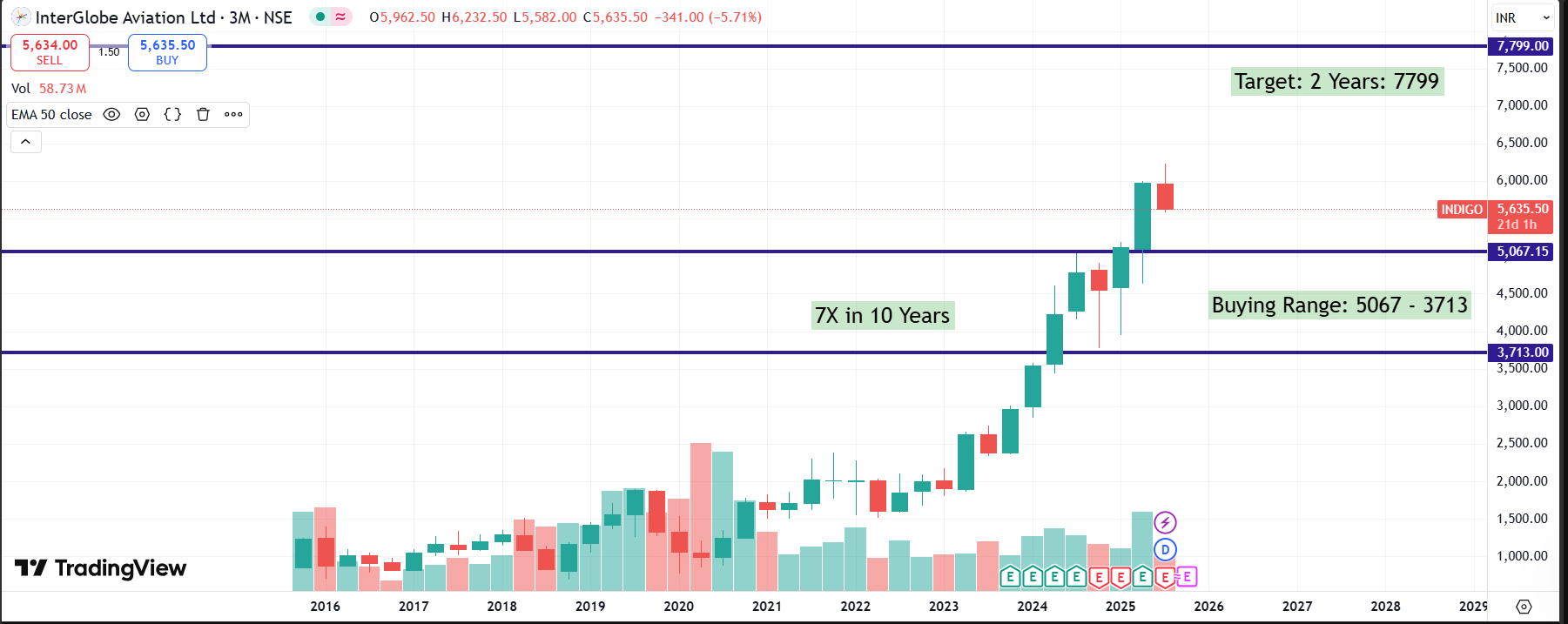
💡 What this means: IndiGo has potential to double in 10 years if it maintains leadership.
⚖️ Risks vs Rewards
Risks:
High dependency on fuel prices & INR vs USD.
Debt-heavy due to leasing model.
Rising competition in international routes.
Rewards:
Strong brand trust in India.
Youngest and largest fleet in India.
Massive Airbus order book (1,000+ planes on order).
Growing demand from Tier-2 & Tier-3 cities.
📌 Conclusion for Long-Term Investors
IndiGo is a clear leader in Indian aviation. It has weathered crises, built the biggest network, and remains highly efficient.
Short term: Expect margin pressures from costs.
Long term: Structural story intact → steady compounding.
Best strategy: Accumulate on market corrections.
📢 Disclosure
This is for educational purposes only. Not investment advice. Do your own research before investing.