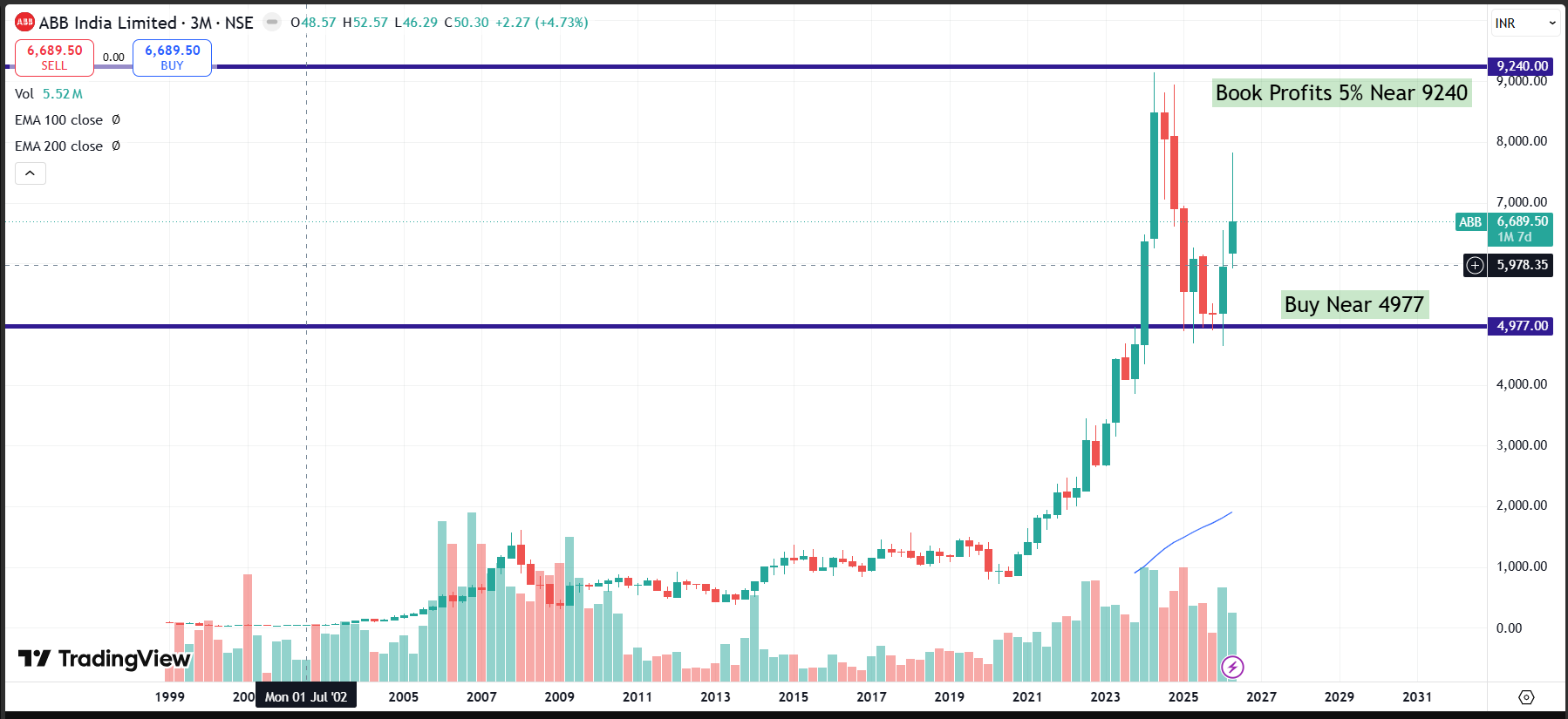
ABB India Q1 CY2026 Analysis: Order Book Hits Record ₹11,000 Cr as Margins Suffer from Commodity Shock
Executive Summary & Quick Verdict
ABB India Limited (ABB) reported a dual-toned set of numbers for Q1 CY2026 (ended March 31, 2026). On one hand, order booking momentum is exceptionally robust, scaling a massive ₹11,000 Crore backlog (driven by data centers, railways, and renewable energy). On the other hand, a combination of input cost inflation (copper, silver, aluminum), currency depreciation, and unfavorable execution mix has led to a significant 576 bps YoY erosion in Operating EBITDA margins.
Crucially, the bottom line is distorted by a massive extraordinary profit of ₹1,441.74 Crore (after tax) resulting from the successfully completed slump sale of the Robotics division to ABB Robotics India Private Limited. Excluding this, core performance highlights a near-term margin squeeze that requires tactical caution.
The Snapshot
The 'Wow' Factor: Key Highlights
Robotics Slump Sale Windfall: ABB booked a post-tax extraordinary profit of ₹1,441.74 Crore on the transfer of its Robotics business, boosting the total quarterly net profit to a historic ₹1,783.65 Crore.
Order Book at Lifetime Highs: Order backlog reached ₹11,000 Crores (growing 25% YoY in total orders), providing strong revenue visibility for the next 5 to 6 quarters.
Severe Margin Atrophy: Operating EBITDA margins fell from 18.59% in Q1 CY2025 to 12.83% in Q1 CY2026, caused by metal price spikes, severe INR depreciation, and competitive pricing pressures.
Massive Cash Pile: Total cash and bank balances jumped to ₹7,600 Crores (including the Robotics sale proceeds), making ABB one of the strongest debt-free balance sheets in the Indian capital goods space.
Operational KPI Table: Segment Performance
ABB operates in three key segments (following the renaming of the Process Automation division to Automation). A deep-dive into segment-wise revenue and margins reveals where the structural pressure lies:
Segment Insights
Electrification: Growth remains solid, anchored by Hyperscale Data Centers and Railways. However, severe inflation in copper and silver, along with the lack of high-margin "lumpy" data center bookings executed in Q1 CY25, dragged EBIT margins down by 956 bps.
Motion: Maintained a resilient volume baseline despite intense pricing pressure from non-traditional Japanese, Korean, and Chinese competitors.
Automation: Suffered from slower private capex decision-making, leading to a 14.67% revenue drop. However, an favorable service-to-project mix protected the margins from a worse fall.
Financial Deep Dive: Income Statement (Consolidated)
All calculations are based on Consolidated Ind AS financials:
Cost vs. Efficiency Analysis
The core issue for the quarter was a rapid rise in input costs. Raw Material Cost + Purchases of Stock-in-Trade (net of inventory changes) stood at 57.6% of revenue (₹1,833.98 Cr) compared to 54.5% in Q1 CY25. This was compounded by a sharp depreciation of the Indian Rupee against the USD and Euro, leading to an exchange loss of ₹27.5 Crores.
Management clarified that the overall margin degradation can be broken down into:
$$\text{Margin Impact} = \underbrace{1.0\%}_{\text{Competitive Intensity}} + \underbrace{2.0\%}_{\text{Forex \& Commodity Spikes}} + \underbrace{1.0\%}_{\text{Execution/Product Mix}}$$
While ABB has taken two price hikes, they operate with a lag of 1–2 quarters, meaning operational margins will likely remain range-bound in the near term.
Peer Benchmarking: ABB India vs. Siemens Energy India
To evaluate ABB's performance objectively, we compare it to its closest listed competitor in the high-voltage transmission and power sector, Siemens Energy India Limited (ENRIN), which reported its March 2026 results recently:
Shareholding Pattern: Institutional Validation
Institutional investors are looking past the short-term margin dip, accumulating shares in the open market:
Promoters: Unchanged at 75.00% (Foreign Promoters: ABB Asea Brown Boveri Ltd). No promoter shares are pledged.
FIIs: Increased to 8.20% (up from 7.65% in Dec 2025).
DIIs: Increased to 9.29% (up from 9.15% in Dec 2025).
Public / Retail: Decreased to 7.52% (down from 8.20% in Dec 2025).
Analysis: Retail investors booking profit was completely absorbed by mutual funds and foreign institutions, indicating a robust institutional "floor" for the stock.
The Forward Curve: Growth Projection
CY2026 Capex Expansion: ABB announced a $75 Million (~₹620 Crore) investment for CY2026 to expand manufacturing facilities and R&D centers in India, with export mandates.
Order Pipeline: Data center capacity addition in India is projected to scale from 2 GW to 10 GW over the next 4 years. Data center bookings currently constitute 12% to 16% of ABB's total order book, presenting an immense long-term addressable market.
Near-Term Projection: We expect revenue to pick up over the next two quarters as supply chain disruptions caused by West Asia ease. We project a 10–12% CAGR in core revenue for the remaining CY2026, with EBITDA margins clawing back to 14.5%–15.0% once the price hikes reflect in the books.
Valuation Guardrails
Historical Comparison: ABB India is currently trading at a TTM P/E of ~92.2x, which is a substantial premium to its 5-year median PE of 68x.
PB Ratio: Trading at 17.3x Book Value, indicating highly optimistic growth expectations are already priced in.
Valuation Category: Trading at a Premium. * Margin of Safety: Low. Any prolonged delay in data center execution or continued metal inflation could trigger a valuation de-rating.
The Advisory Note
Strategic Outlook (Long-Term Thesis)
The structural growth story of ABB India remains completely intact. As a primary beneficiary of India's grid modernization, massive data center additions, and rapid railway electrification, ABB represents a high-quality "picks-and-shovels" play on the Indian capex cycle. Furthermore, the ₹7,600 Crore cash pile provides the balance sheet with defensive resilience and the capacity to invest heavily in future localized products.
Tactical Outlook (Short-Term View)
In the short term, the market is likely to react negatively to the sharp deterioration in operating margins and the modest 5.78% core top-line growth. Investors should not buy into the "extraordinary" net profit figure as it is a one-off capital gain.
We recommend a "Buy on Dips" approach. If the stock experiences a correction of 8–10% on margin disappointments, it represents a highly attractive long-term entry point.
FairValue: https://docs.google.com/spreadsheets/d/e/2PACX-1vTDD_bDv48lWghVJhbGAEB2Nd81POpilszu5MXT5AdeQwlKOquXd9vj_MrOgxkVu7DuIdOubdGkqbsO/pubhtml?gid=2085187615&single=true
Professional Financial Disclaimer
Disclaimer: This analysis is for educational and informational purposes only and does not constitute financial advice.