AU Small Finance Bank Q3FY26 Results: A Deep Dive into 26% Profit Growth and Strategic Expansion
What Investors Need to Know About the Universal Bank Transition
AU Small Finance Bank, a rapidly growing player in the Indian banking sector, has delivered a strong financial performance for the third quarter of FY26. This post unpacks the drivers behind this robust performance, analyzes the bank's strategic positioning for its universal banking transition, and assesses the sustainability of its growth for investors.
--------------------------------------------------------------------------------
1. Q3 FY26 Performance Snapshot: The Numbers at a Glance
The following table presents the financial and operational highlights for the quarter ended December 31, 2025.
--------------------------------------------------------------------------------
2. Key Highlights from Q3FY26
The quarterly performance was marked by significant achievements across profitability, business expansion, and operational efficiency.
Strong Profitability Growth: A standout achievement this quarter was the bank’s 26% year-over-year growth in Profit After Tax (PAT) to ₹668 Cr. This was driven by a healthy 9% sequential expansion in Net Interest Income (NII) and a sharp reduction in credit costs (down 31% QoQ). Analyst's Take: This jump in profitability, driven by both core income growth and lower provisioning, signals a potential return to stronger earnings momentum after a period of consolidation.
Robust Business Expansion: AU Bank demonstrated impressive business momentum, with total deposits growing by 23.3% YoY to ₹1.38 Lacs Cr, significantly outpacing the banking sector's average growth of ~12.7%. The Gross Loan Portfolio also expanded by a healthy 19.3% YoY to ₹1.30 Lacs Cr. Analyst's Take: Outpacing the sector average so significantly in deposit growth is a critical advantage, as a strong, granular deposit base is key to managing funding costs and supporting loan growth in a competitive environment.
Improving Margins and Asset Quality: The bank reported a notable improvement in its Net Interest Margin (NIM), which expanded by 25 basis points sequentially to 5.7%. This crucial margin recovery was directly fueled by a 22 basis point QoQ decline in the Cost of Funds to 6.61%, demonstrating effective liability management. Asset quality also saw improvement, with Gross Non-Performing Assets (NPAs) declining to 2.30% and a 13% sequential drop in fresh slippages.
--------------------------------------------------------------------------------
3. Profitability, Valuation, and Future Outlook
Profitability Ratios
The key profitability ratios for Q3FY26 stand as follows:
Return on Assets (RoA): 1.6%
Return on Equity (RoE): 14.3%
Valuation Snapshot
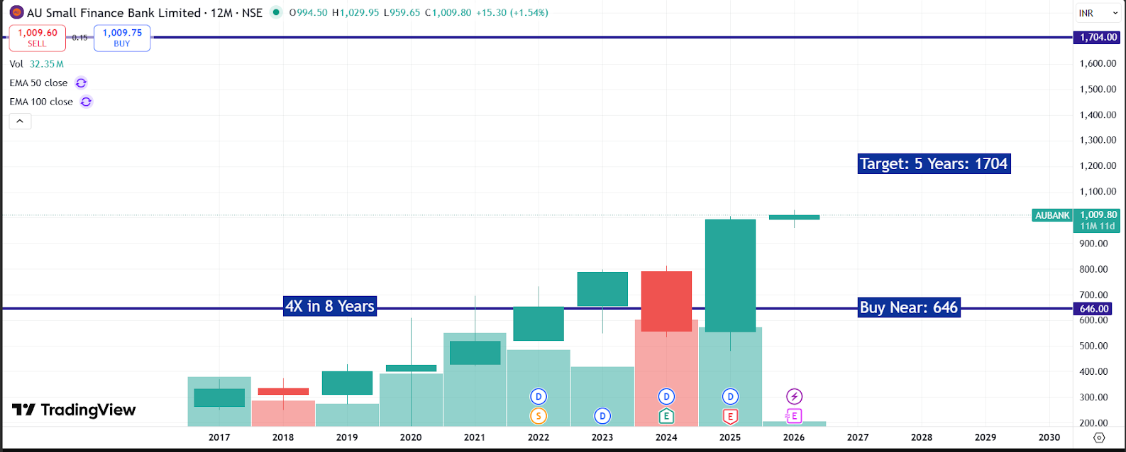
Based on a Current Market Price (CMP) of ₹989, the bank's valuation metrics are:
Book Value Per Share (BVPS): ₹255 (as of Q3FY26)
Price to Book Value (P/B): 3.88x
Capital Adequacy Ratio (CRAR): Its Capital Adequacy Ratio (CRAR) of 19.0% (as of Dec 31, 2025) indicates the bank is well-capitalized, providing a strong buffer against unforeseen risks and ample runway to fund its growth ambitions.
Management's Future Growth Outlook
The management has outlined a clear strategy for its next phase of growth, with several key drivers:
Universal Banking Transition: The bank is focused on its transition to a Universal Banking platform. This strategic shift is aimed at strengthening the AU brand, widening its acceptance, and lowering the overall cost of funds.
Key Growth Engines: Management has identified several key business verticals as primary growth engines. These include Wheels (vehicle finance), Gold Loans, Mortgages, Commercial Banking, and scaling up the cross-selling of products like insurance, credit cards, and wealth management services.
Digital and AI Transformation: An enterprise-wide Agentic AI roadmap has been established. This initiative aims to transform customer engagement through AI-first platforms and drive significant operational efficiency across the bank.
Distribution Expansion: The bank continues its aggressive physical expansion, having added 100 new touchpoints in Q3. The focus is clearly strategic, with a significant portion of these being liability-focused branches (27 new liability branches) in urban markets, directly supporting the goal of lowering the cost of funds.
--------------------------------------------------------------------------------
4. Analyzing the 9-Month Trend (9M'FY26)
Looking at the performance for the nine months ended December 31, 2025, the bank has demonstrated a consistent growth trajectory. For this nine-month period, AU Bank reported a 13% year-over-year growth in Profit After Tax, a 17% YoY growth in Total Income, and a 10% YoY growth in Net Interest Income. This steady performance underscores the bank's sustained momentum throughout the current fiscal year.
--------------------------------------------------------------------------------
Conclusion and Next Steps
The Q3 results provide tangible evidence that AU Bank's strategic bets—on expanding its liability franchise and leveraging technology—are beginning to pay off. For investors, the key monitorable ahead will be whether the bank can maintain this margin and asset quality discipline as it scales up and transitions into a universal bank.
A detailed valuation and its place in our Wealth-Building Strategy is available for premium members. Find the Fair Value at https://docs.google.com/spreadsheets/d/e/2PACX-1vRg1tSKFe-u3gKrsjyojpraa0BgCp8uc91CDC5EW5wLCHb_RJ8_6sbNVHNBNtQ6Ww/pubhtml?gid=69417233&single=true
--------------------------------------------------------------------------------
Disclosure
Disclosure: The author is a SEBI registered investment advisor. This article is for informational and educational purposes only and should not be considered as direct financial advice or a recommendation to buy or sell any stock. The analysis is based on publicly available information and financial statements released by the company. The author and their clients may or may not have a position in the stocks mentioned.