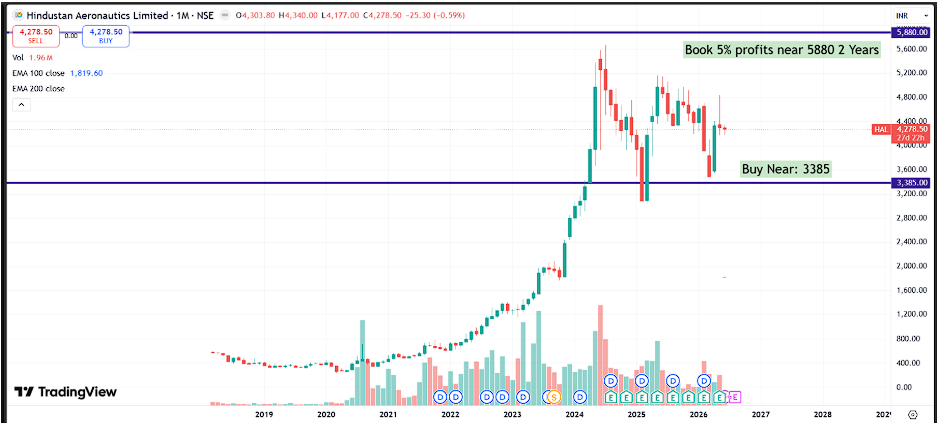
HAL Q4 FY26 Analysis: Decisive Order Book Expansion vs. Engine-Supply Bottlenecks
The Indian defense and aerospace landscape is undergoing a structural, multi-decade indigenization transformation. At the very center of this shift sits Hindustan Aeronautics Limited (HAL), a Maharatna CPSE tasked with executing India’s core combat aviation pipeline.
Yesterday, HAL declared its consolidated and standalone financial results for the fourth quarter and full fiscal year ended March 31, 2026 ($FY26$). Our detailed investment update examines the fine print of these numbers, breaking down the operational metrics, core margins, structural cost shifts, and valuation guardrails to help our fund clients and students of finance evaluate if the current market price offers a reasonable Margin of Safety.
1. The Snapshot
2. The "Wow" Factor
Massive Order Backlog: HAL’s order book stands at a historic $\text{Rs. } 2,54,538 \text{ Crore}$ (net of $FY26$ revenues). This is equivalent to a massive $7.69\text{x}$ of its $FY26$ revenue, guaranteeing exceptional long-term revenue visibility.
Impeccable Balance Sheet Strength: The company remains completely debt-free with zero promoter pledges, backed by cash and bank balances of $\text{Rs. } 42,425 \text{ Crore}$, providing huge defensive cushioning.
Strong Intellectual Capital: HAL spent $\text{Rs. } 2,794 \text{ Crore}$ ($8.44\%$ of sales) on R&D in $FY26$, filing $223$ new Intellectual Property Rights (IPR) applications, bringing its cumulative granted patents to a record $1,226$.
The ROH Cushion: High-margin Repair & Overhaul (ROH) revenues stood at $\text{Rs. } 20,524 \text{ Crore}$, making up $62\%$ of the top line. This recurring services business effectively shielded overall profits when core manufacturing shipments faced delays.
3. Operational KPI Table
To understand the core performance drivers in the aerospace sector, we track the following key operational parameters:
4. Financial Deep Dive
HAL's financial results demonstrate stable revenue growth accompanied by resilient operating profitability. Below is the consolidated financial performance comparison:
Consolidated Financial Performance Table (values in $\text{Rs. Crore}$)
Note: EBITDA is calculated as:
$$\text{EBITDA} = \text{Profit Before Tax (PBT)} + \text{Depreciation} + \text{Finance Costs}$$
Cost vs. Efficiency Analysis
HAL's full-year EBITDA margin remained exceptionally robust, expanding to $40.84\%$ at the gross consolidated level, while core operating EBITDA margins stabilized around $30\%\text{ to }31\%$. This profitability was protected by high-margin ROH contracts. However, from a Margin of Safety perspective, we highlight two critical structural cost variances:
Gratuity and Employee Benefit Shocks (Note 14): Due to the rise in Industrial Dearness Allowance (IDA) to $51.80\%$ in October 2025, the statutory gratuity ceiling for HAL employees was automatically raised from $\text{Rs. } 20 \text{ Lakhs}$ to $\text{Rs. } 25 \text{ Lakhs}$ (triggered whenever IDA crosses $50\%$). This adjustment resulted in a massive, one-time additional liability of $\text{Rs. } 32,733 \text{ Lakhs}$ ($\text{Rs. } 327.33 \text{ Crore}$) in $FY26$, impacting employee benefit expenses.
Wage Revision Settlements (Note 4): Following the Hon’ble High Court of Karnataka's ruling in favor of the employees' union (HAEA) regarding wage refixations, HAL had to reverse prior capitalized/claimed increment-related recoveries to the tune of $\text{Rs. } 16,390 \text{ Lakhs}$ ($\text{Rs. } 163.90 \text{ Crore}$). This reversal creates a higher structural base for employee cost run-rates going forward.
Capital Efficiency Drag: While operating cash flows remain strong at $\text{Rs. } 10,906 \text{ Crore}$, the company’s raw material and WIP inventory ballooned to $\text{Rs. } 30,850 \text{ Crore}$, of which $\text{Rs. } 8,100 \text{ Crore}$ is tied up in the LCA program alone. This inventory represents fully assembled airframes awaiting foreign-sourced engines, acting as a near-term drag on capital efficiency and cash conversion.
5. The Forward Curve
Based on guidance provided by the newly appointed Chairman and Managing Director, Shri Ravi Kota, we project the next phase of execution:
FY27 Revenue Guidance: Management has projected $10\% \text{ to } 12\%$ YoY consolidated revenue growth for $FY27$, with operating EBITDA margins expected to remain stable at $30\% \text{ to } 31\%$.
The LCA Delivery Ramp-up: HAL is targeting $20 \text{ LCA Mark-1A}$ deliveries in $FY27$. The execution is heavily dependent on GE Aviation's commitment to ship the pending F404 engines starting August/September 2026. Because the lead time between engine integration and final delivery is $\approx 30 \text{ to } 45 \text{ days}$, the schedule for the second half of $FY27$ remains very tight.
HTT-40 and Helicopter Pipelines: Deliveries of the indigenously designed HTT-40 are scheduled to begin in $FY27$, with a target of $20+ \text{ aircraft}$. Helicopter deliveries also remain on track, with the final $10 \text{ ALH}$ units for the Army being shipped in the near term.
Order Pipeline: HAL expects to book $\text{Rs. } 90,000 \text{ Crore}$ in fresh orders over the next 24 months, led by the $143 \text{ ALH}$ contract for the Armed Services, Su-30 MKI upgrades, and Dornier-228 upgrades. The landmark Su-30 MKI ($12 \text{ aircraft}$) order will begin execution in $FY28$ ($1 \text{ unit}$) and complete in $FY29$ ($11 \text{ units}$).
6. Valuation Guardrails
To evaluate whether HAL’s current stock price offers a sufficient margin of safety, we compare its trailing multiples against its historical averages:
Current Price-to-Earnings (P/E) Multiple:
$$\text{Current P/E} = \frac{\text{CMP (Rs. 4,278)}}{\text{TTM Consolidated Diluted EPS (Rs. 136.30)}} \approx \mathbf{31.38x}$$
5-Year Median P/E Multiple: $\approx \mathbf{21.50x}$
Premium to Historical Valuation: $+45.95\% \text{ Premium}$
Current Price-to-Book (P/B) Ratio: $\approx \mathbf{6.93x}$ (vs. 5-Year Median P/B of $6.3x$)
Valuation Verdict: Trading at a Premium
At a current P/E of $31.38x$, HAL is trading at a significant premium of $\approx 46\%$ to its 5-year historical median of $21.50x$. While a structural re-rating is justified by the massive ₹2.54 Lakh Cr order book and India’s defense policies, the current valuation leaves little room for execution errors.
The reliance on international OEMs (GE and Honeywell) for core propulsion systems continues to expose the company to shipment delays, making the near-term delivery schedule vulnerable.
7. Shareholding Pattern Analysis
We analyzed the latest shareholding filing for the quarter ended March 31, 2026:
[Promoters: 71.64%] ─────────────────────────────────► (Unchanged, GoI holds absolute control)
[FIIs: 10.20%] ───► (Slightly decreased from 10.86% in Dec 2025; minor foreign profit booking)
[DIIs: 10.40%] ───► (Increased from 9.66% in Dec 2025; Domestic MFs increased to 5.81%)
[Public/Retail: 7.76%]
[Pledged Shares: 0.00%] ◄────────────────────────────── (Perfect risk profile; Zero pledges)
Promoter Group: The President of India maintains a stable $71.64\%$ stake, confirming solid government backing.
Foreign Institutional Investors (FIIs): Reduced their stake slightly from $10.86\%$ to $10.20\%$ over the quarter, indicating a small reduction in exposure at these premium valuation levels.
Domestic Institutional Investors (DIIs): Continued to increase their holdings, rising from $9.66\%$ to $10.40\%$, led by Mutual Funds (now at $5.81\%$).
Pledge Data: Promoters have $0.00\%$ pledged shares, which, combined with the zero-debt status, provides a clean balance sheet.
8. The Advisory Note
Strategic Outlook (Long-Term Thesis)
HAL remains a core structural holding for a long-term defense portfolio. Its long-term competitive moat is solid, supported by:
An unmatched order backlog of $\text{Rs. } 2.54 \text{ Lakh Crore}$.
Critical technology transfer agreements, such as manufacturing rotating parts for LEAP civil engines with Safran and the SSLV technology transfer with ISRO.
A steady, high-margin revenue stream from its Repair & Overhaul (ROH) and Spares businesses.
We view the company as a key beneficiary of the long-term indigenization trend.
Tactical Outlook (Near-Term Positioning)
From a near-term perspective, we recommend caution. At a CMP of $\text{Rs. } 4,278$, the stock is trading well above its historical valuation guardrails. Given the high reliance on international engine shipments (GE Aviation and Honeywell) and the resulting inventory buildup, any further delay in engine deliveries could lead to missed quarterly revenue targets.
Investment Stance: We advise holding existing positions but deferring large fresh capital deployments at current multiples. Tactical investors should look to accumulate the stock on corrections closer to the $\text{Rs. } 3400, where a much stronger Margin of Safety exists.
Mandatory Financial Disclosure
Disclaimer: This report is generated solely for educational and informational purposes for our clients and finance students. It does not constitute formal, SEBI-registered investment advice. Investing in equities involves market risks, and defense PSU stocks are subject to specific government policy decisions and long-cycle execution risks.