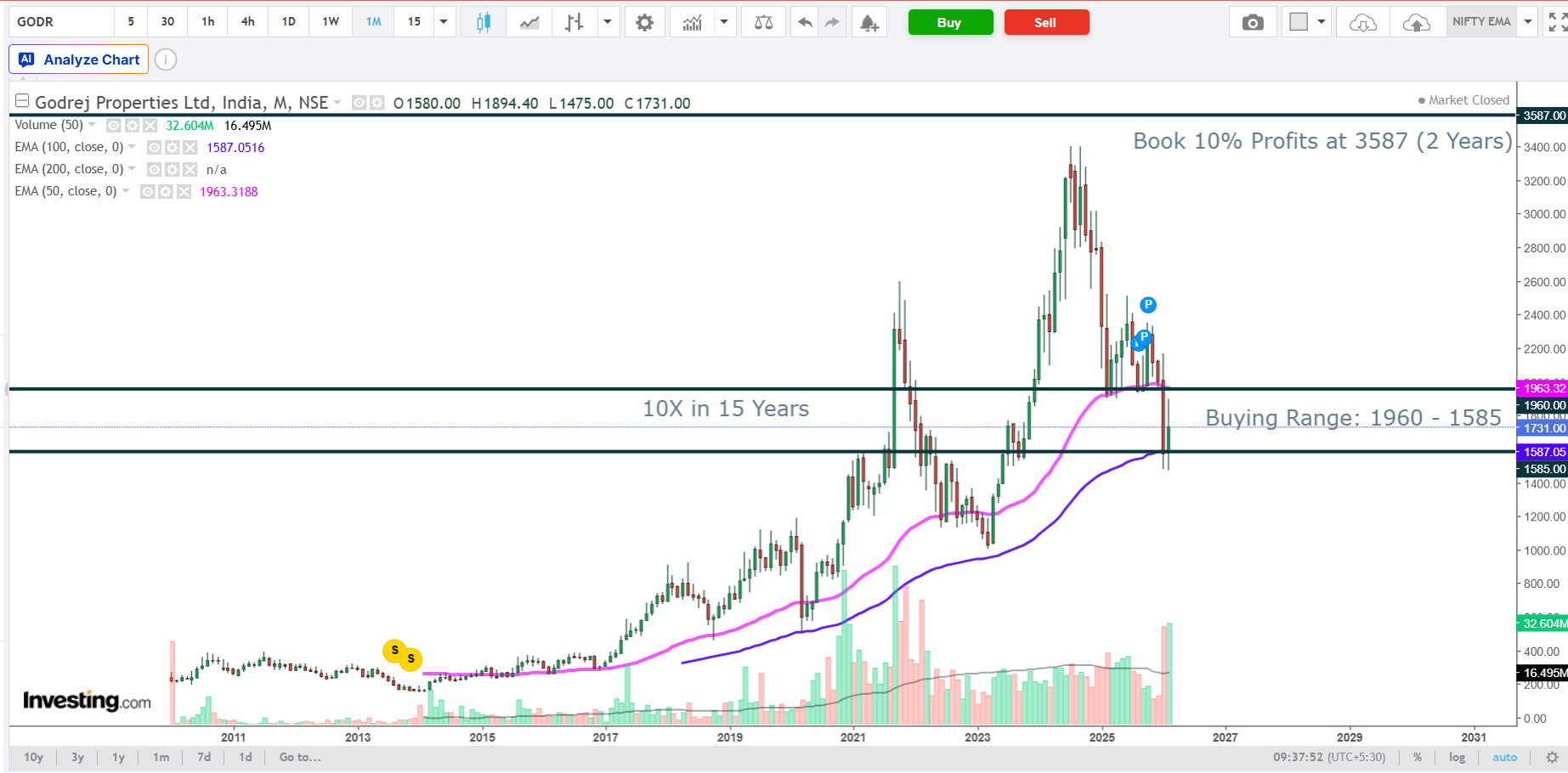
Godrej Properties Q3 FY26 Analysis: Blockbuster Pre-Sales vs. Operational Revenue Paradox
By the Equities Strategy Desk Published for Our Investors and Registered Students.
In the real estate sector, there is a fundamental divergence between the cash a developer collects today and the revenue it recognizes on the income statement tomorrow. Godrej Properties' (GPL) Q3 FY26 results serve as a masterclass in this accounting paradox. While the street celebrates an unprecedented surge in pre-sales, our "Margin of Safety" framework compels us to look beneath the hood at collapsing core revenues and the heavy reliance on non-operating income to mask operational deficits.
Here is our elite institutional breakdown of Godrej Properties' latest quarter.
The Snapshot: Godrej Properties Ltd (Consolidated)
The 'Wow' Factor
Booking Value Bonanza: Highest-ever Q3 booking value of ₹8,421 Cr (a massive $55\%$ YoY jump), driven heavily by the MMR region (specifically the Godrej Trilogy launch in Worli).
The "Other Income" Mirage: Consolidated $PAT$ jumped by $20\%$, but this was entirely engineered by a $97.5\%$ YoY surge in "Other Income" (₹535.48 Cr) stemming from a fair-value gain on a JV acquisition. Core operations posted an EBITDA loss.
Cash Flow Divergence: While core P&L revenue collapsed, actual cash collections on the ground grew by $40\%$ YoY to a robust ₹4,282 Cr, showcasing strong execution on existing inventory.
Promoter Skin in the Game: Promoters quietly increased their stake by $0.12\%$ through open market purchases (aggregating ~₹300 Cr), signaling internal confidence despite P&L volatility.
Operational KPI Table
Real estate valuations are inherently tied to future cash flows rather than historical accounting. Here is how GPL performed on its core operational metrics:
Financial Deep Dive (Consolidated P&L)
Due to Ind-AS 115 (Project Completion Method), GPL's P&L reflects past deliveries rather than current sales. The Q3 FY26 P&L shows a drastic mismatch.
Cost vs. Efficiency Analysis
Maintaining our strict Margin of Safety ethos, the operational efficiency this quarter raises immediate red flags. While core operational revenue plummeted by almost $50\%$, fixed costs did not adjust. Employee benefit expenses rose by $13.92\%$ YoY to ₹129.82 Cr.
This signifies severe negative operating leverage. The formula for operational health is deteriorating:
$Operating\ Margin\ (Excl.\ OI) = \frac{EBITDA_{Core}}{Revenue} \times 100 = -36.67\%$
The reported $PAT$ of ₹195.16 Cr is entirely a byproduct of financial engineering via "Other Income" (₹535.48 Cr). Without this non-operating JV gain, the firm would have reported a steep loss. Additionally, Net Debt-to-Equity crept up from $0.30x$ to $0.37x$, indicating that balance sheet leverage is expanding to fund the aggressive land acquisition pipeline while P&L cash generation lags.
Management Integrity and Tone
Analyzing the earnings call transcripts, management's tone can be described as highly confident on macro demand, yet mildly defensive regarding accounting optics. Executive Chairperson Pirojsha Godrej transparently acknowledged the lumpiness of revenue recognition, directing investor focus toward the $55\%$ surge in pre-sales and the $40\%$ jump in collections. The integrity remains intact, but the management was quick to brush past the escalating debt levels and negative operating cash flows, leaning heavily on the "future cash flow visibility" argument.
Peer Benchmarking
How does GPL stack up against its closest competitors?
DLF Ltd (M-Cap ~₹1.55L Cr): DLF boasts vastly superior operating margins and a massive annuity portfolio, sheltering it from the cyclical lumpiness GPL experiences.
Macrotech Developers / Lodha (M-Cap ~₹1.07L Cr): Lodha has been aggressively de-leveraging, whereas GPL is currently re-leveraging to acquire land.
Capital Efficiency: Godrej’s $ROE$ currently sits at a mere $6.57\%$, significantly lagging behind industry peers.
The Forward Curve
Looking ahead to Q4 FY26 and Q1 FY27, we project:
Revenue Catch-up: Expect a sudden spike in recognized revenues in H1 FY27 as several delayed MMR and NCR projects hit the completion threshold.
Guidance Beat: With 74% of the ₹32,500 Cr target already achieved, historical seasonality suggests Q4 will easily push GPL past its annual booking guidance, likely touching ₹34,000 Cr.
Debt Watch: We anticipate gross debt to peak in the next two quarters as the company digests its recent aggressive land acquisitions.
Valuation Guardrails & Shareholding
Valuation Verdict: TRADING AT A PREMIUM. At a CMP of ₹1,729, GPL trades at a trailing $\frac{Price}{Earnings}$ ratio of roughly $30.04x$. However, because earnings are artificially inflated by one-off gains, the core operational P/E is essentially non-existent (negative). The Price-to-Book ($\frac{P}{B}$) ratio sits at $3.68x$, placing it above its 5-year historical median. The market is pricing in flawless execution of the current pre-sales book.
Shareholding Shifts: Notably, Promoters bought the dip, increasing their stake slightly from $47.05\%$ to $47.17\%$ in recent months. Meanwhile, FIIs trimmed exposure from $28.31\%$ to $28.14\%$, and Domestic Mutual Funds absorbed the difference, raising their stake to $7.38\%$.
The Advisory Note
Strategic Outlook (Long-Term): Godrej Properties remains a formidable compounding machine for patient capital. The brand equity is unmatched, and the transition from a capital-light JV model to a higher-margin outright land purchase model will pay massive dividends 3-5 years out.
Tactical Outlook (Short-Term): The stock is vulnerable. The optics of collapsing revenues, combined with a negative operational EBITDA, limit near-term upside. At ₹1,729, there is an insufficient Margin of Safety. We advise waiting for a broader market correction to accumulate in the ₹1,450 - ₹1,550 zone.
Mandatory Financial Disclosure: This report is for educational and informational purposes only and does not constitute personalized investment advice. Real estate equities are subject to extreme cyclicality.