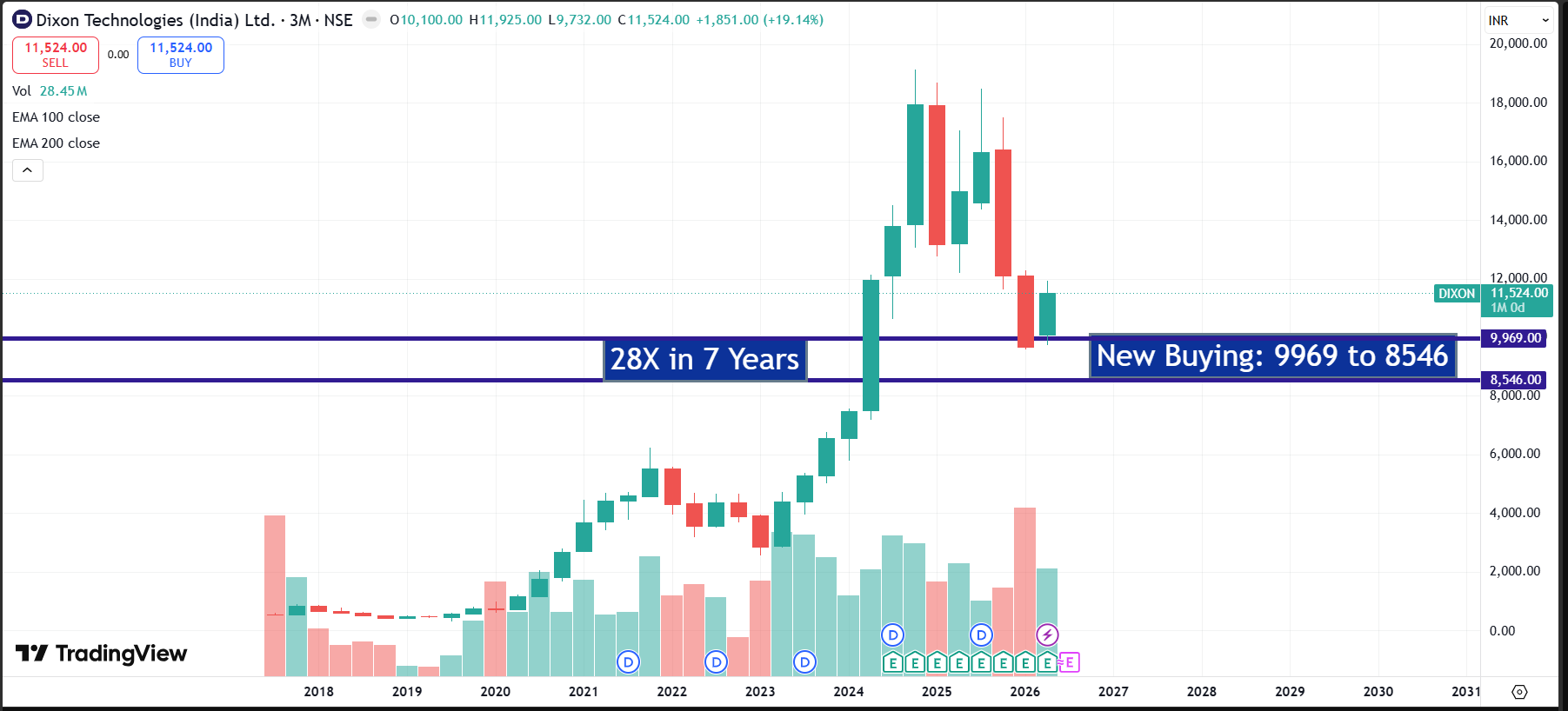
Dixon Technologies Q4 FY26 Analysis: Strong FY26 Finish vs. Near-Term Mobile Headwinds
The following is an analysis of Dixon Technologies' Q4 and FY26 financial results, derived from the company's financial statements, earnings presentation, and earnings call transcript.
The Snapshot
The 'Wow' Factor
Robust Free Cash Flow: Despite a sluggish environment and Rs. 1,058 crores in CapEx, Dixon generated a strong Free Cash Flow of Rs. 724 crores in FY26.
Exceptional Return Ratios: The company maintained stellar return metrics with an ROCE of 44.8% and an ROE of 28.1% for FY26.
Stellar Working Capital Management: Dixon achieved a negative working capital cycle of 8 days, demonstrating high operational efficiency.
Aggressive Capacity Expansion: Plans to expand camera module capacity from 70M to 180M-190M units and operationalize a massive display facility in Q3/Q4 FY27 highlight aggressive scaling.
Operational KPI Table
*Includes ~4.5M export units.
Financial Deep Dive
Note: Adjusted figures exclude fair value gains on the Aditya Infotech stake and the gain on the transfer of the lighting business.
Cost vs. Efficiency:
Dixon faced margin compression in Q4 FY26, with adjusted EBITDA margins contracting 40 bps YoY to 4.0%. This was primarily driven by the mobile segment, where memory price inflation increased the Bill of Materials (BOM), thereby inflating revenue without a proportional increase in absolute EBITDA per unit. The end of the mobile PLI scheme also exerted downward pressure on margins. However, the company successfully offset some of these pressures through enhanced operational efficiencies and a strict focus on working capital, ending the year with negative 8 working capital days. Management maintains a margin of safety approach, noting that while short-term optical margins may appear lower due to higher Average Selling Prices (ASPs), absolute per-unit profitability remains intact.
Management Integrity and Tone
The tone of Mr. Atul Lall (MD) and Mr. Saurabh Gupta (CFO) was confident and transparent. They openly acknowledged the short-term headwinds regarding sluggish volume growth and margin pressures stemming from elevated memory prices and the conclusion of the mobile PLI scheme. Management proactively addressed the strategic "miss" in not entering the high-margin industrial EMS segment earlier but provided concrete, actionable plans to rectify this via partnerships and potential M&A. Their disclosure regarding the outstanding PLI receivables (Note 11) further reinforces transparency.
Key Risks and Red Flags
Margin Compression: The expiration of the mobile PLI scheme and rising input costs (memory chips) will likely keep margins under pressure in FY27 before backward integration benefits materialize.
Customer Concentration/Approval Delays: The anticipated volume boost from Vivo remains contingent on pending government approvals, posing a risk to the projected ~15-17% base growth if delayed further.
Contingent PLI Receivables: A significant Rs. 1,110 Cr receivable is contingent on government disbursement regarding the 'overflow' mechanism of the PLI scheme (matched by a Rs. 726 Cr payable). While supported by legal opinion, this remains a regulatory risk.
The Forward Curve
Management guided for a robust 15-17% revenue growth in FY27 excluding potential Vivo volumes, targeting approximately Rs. 56,000 crores. In the near term (next two quarters), the mobile segment is expected to see "high double-digit" sequential volume growth and a 12-15% increase in realizations. The IT hardware segment is projected to grow 3x YoY, and the lighting segment (via the Signify JV) is expected to double its revenue in the current fiscal year. The commencement of trial production for display modules and SSDs in Q3 FY27 will be critical milestones to monitor.
Valuation Guardrails
While specific PE/PB ratios require the current stock price and updated historical data, Dixon typically trades at a premium due to its high growth rates and dominant market share in the Indian EMS space. Given the robust FY26 execution, strong cash flow, and visibility into new segments, the stock is likely Trading at a Premium, pricing in significant future growth from backward integration and new vertical expansion.
Holding Pattern Updates
No significant changes in the shareholding pattern (Promoter/FII/DII/Public stake or Pledges) were highlighted in the provided earnings call transcript or financial results.
The Advisory Note
Strategic vs. Tactical:
Strategic (Long-term): Dixon remains a premier play on the "Make in India" and global supply chain diversification themes. The strategic pivot towards backward integration (displays, camera modules) and entry into high-margin, sticky businesses (Industrial EMS, Servers, Telecom) solidifies its long-term moat and promises margin expansion in FY28 and beyond.
Tactical (Short-term): Investors should be prepared for optical margin compression in FY27 due to PLI phase-outs and higher ASPs. However, the anticipated volume recovery in H2 FY27 and the potential Vivo approval provide near-term catalysts.
Disclaimer: This analysis is for informational purposes only and does not constitute financial advice.