Mahindra & Mahindra Q4 FY26 Analysis: Unprecedented SUV & EV Traction vs. International Farm Headwinds
Published By: ProfitFromIt Research Desk
At our advisory firm, we maintain a strict 'Margin of Safety' mindset. We look beyond the headline numbers to dissect operational efficiency, management integrity, and underlying cash flows. Mahindra & Mahindra (M&M) has delivered a transformational FY26, but does the current valuation justify the underlying growth? Let us break down the consolidated quarterly results, management transcripts, and valuation guardrails.
1. The Snapshot
2. The 'Wow' Factor
Here are the most surprising and impactful data points from the Q4 FY26 results:
EV Market Dominance: M&M hit an EV penetration rate of $9.6\%$ in Q4, crossing into double digits in the final months of the fiscal year. They have secured the #1 rank in eSUV Revenue Market Share at an impressive $37.7\%$.
Ruthless Capital Discipline: Management took a Rs. 1,400 Cr impairment hit to exit structurally weak international farm subsidiaries (Sampo, Erkunt, and MAM Japan), prioritizing long-term ROE over vanity revenue.
AI-Driven Growth: M&M is aggressively deploying AI. The launch of the XUV 7XO utilized AI for WhatsApp customer engagement, directly leading to 17,000 incremental test drives.
RoE Expansion: The consolidated Return on Equity (ROE) hit an exceptional $20.1\%$, proving that aggressive EV CAPEX can coexist with strong shareholder returns.
3. Operational KPI Table
To understand the core growth engines, we must look at the physical volume and market share metrics.
4. Financial Deep Dive (Consolidated)
Note: All figures are in Rs. Crores unless otherwise specified.
Formula used for EBITDA calculation:
$$EBITDA = \text{Profit Before Tax & Exceptional} + \text{Finance Costs} + \text{Depreciation & Amortisation}$$
Cost vs. Efficiency Analysis
While revenue surged $29\%$ YoY, consolidated EBITDA grew at a slightly slower pace of $24.4\%$. Consequently, the EBITDA margin compressed slightly. This was driven by a sharp $23.7\%$ YoY increase in the Cost of Materials Consumed (Rs. 31,139 Cr vs Rs. 25,172 Cr).
However, management displayed an excellent "Margin of Safety" mindset. Despite raw material inflation and supply chain bottlenecks (particularly around memory chips), strong operating leverage and tight control on Employee Benefits Expense allowed them to generate a remarkable $42\%$ surge in bottom-line PAT. The deliberate impairment hit taken in the Farm segment is a one-time "clean-up" cost that structurally improves future margins.
5. The Forward Curve
Based on management guidance and underlying macros, here is our projection for the next two quarters (H1 FY27):
Auto Segment: We project mid-to-high teens growth. The capacity debottlenecking (scaling from 54k ICE capacity to 64.5k total capacity) and the full operationalization of the new MEAL EV plant will unlock trapped demand.
Farm Segment: We project a conservative mid-single-digit growth ($\approx 5\%$). The base effect is highly elevated, and the upcoming quarters will hinge heavily on spatial monsoon distribution.
Financial Services (MMFSL): Poised for high-teens growth in disbursements, leveraging AI-agentic operations to reduce document processing time from 40 minutes to under 7 minutes.
6. Management Integrity and Tone
Our analysis of the Q4 earnings call transcript reveals a tone that is highly transparent, confidently aggressive, and structurally defensive.
Dr. Anish Shah did not shy away from the failures of the international farm subsidiaries, transparently stating that they were "dragging the international business" and required immediate capital reallocation. There was zero defensive posturing. Furthermore, the management's discussion on AI was grounded in reality—focusing strictly on ROI, cost-reduction, and customer test-drive generation, rather than empty tech jargon.
7. Peer Benchmarking
When compared to its closest domestic peer, Tata Motors, M&M is demonstrating superior agility in the EV transition. While Tata Motors had the early mover advantage, M&M's aggressive rollout of the XEV 9E and 9S has catapulted them to the #1 rank in eSUV Revenue Market Share ($37.4\%$ for FY26). In the ICE SUV space, M&M maintains its stronghold with a $25.3\%$ revenue market share, heavily outpacing Maruti Suzuki in average realization per vehicle due to a premium product mix (XUV700, Scorpio-N, Thar).
8. Key Risks and Red Flags
To build trust and objectivity, we must highlight the headwinds mentioned during the earnings call:
Supply Chain Fragility: Management explicitly noted ongoing shortages in memory chips (DRAM), requiring costly aftermarket purchases to keep production lines running.
Geopolitical and Logistics Risks: M&M heavily monitors high-risk part families. Global freight volatility remains a threat to their export ambitions.
Monsoon Dependency: Despite diversification, domestic tractor sales remain disproportionately tethered to erratic climate patterns and rural inflation.
9. Shareholding Pattern Updates
A significant shift in institutional ownership occurred over the last 12 months:
FII Stake: Decreased from $38.30\%$ (Mar '25) to $36.22\%$ (Mar '26).
DII Stake: Increased proportionately from $29.79\%$ (Mar '25) to $31.50\%$ (Mar '26).
Promoter Stake: Remained rock-solid at $18.45\%$.
Takeaway: Domestic Institutional Investors (Mutual Funds, LIC) are aggressively absorbing the foreign sell-off, signaling massive long-term domestic conviction in M&M's capital allocation and EV strategy.
10. Valuation Guardrails & Advisory Note
P/E Ratio: Trading at $\approx 21.18x$ trailing earnings.
Historical Context: The 5-year median P/E for M&M has hovered around $15x - 18x$.
Verdict: Trading at a Premium. Strategic vs. Tactical Outlook:
Strategic (Long-Term): M&M is a core portfolio hold. Their successful transition to a tech-enabled, EV-forward manufacturer while maintaining a $20\%$ ROE justifies a structural rerating. The cleanup of international subsidiaries removes a multi-year ROE drag.
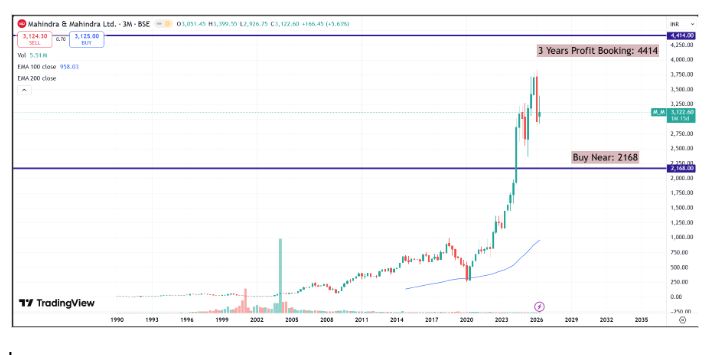
Tactical (Short-Term): At current valuations of Rs. 3,123, much of the immediate growth is priced in. Value-conscious investors should wait for broader market corrections or monsoon-related dips to accumulate.
Financial Disclosure: This report is for educational and informational purposes only and does not constitute registered investment advice. Equity investments are subject to market risks.