🏍️ Bajaj Auto Q4 FY26 Analysis: Record Volumes & KTM Consolidation vs. Moderating Forward Demand
As elite equity research analysts, we continuously parse through the noise to bring our fund clients and financial literacy students the signal. In Q4 FY26, Bajaj Auto delivered a landmark quarter, fueled by aggressive volume expansion across every segment and a massive bottom-line surge resulting from the strategic consolidation of KTM AG.
💡 The Bottom Line: Armed with over ₹8,000 crore in free cash flow, Bajaj has chosen to reward shareholders with a 100% PAT payout. However, underlying market indicators suggest domestic 2W growth is beginning to cool.
Here is our comprehensive, unbiased deep-dive into Bajaj Auto’s Q4 FY26 earnings, management tone, and valuation guardrails.
📊 The Snapshot
🌟 The 'Wow' Factor
✅ 100% PAT Payout Signal: The board distributed its entire FY26 standalone PAT back to shareholders via an aggressive ₹150/share final dividend and a massive ₹5,633 crore share buyback (at ₹12,000/share—a 14% premium).
✅ The KTM Consolidation Surge: Acquiring a controlling stake in Pierer Mobility AG (now Bajaj Mobility AG) triggered a one-time consolidated PAT surge of 103% YoY, closing Q4 at a colossal ₹3,662 crore.
✅ EV Market Penetration: The Chetak EV franchise officially crossed the 1,00,000 retail sales milestone in a single quarter, pushing full-year EV revenues beyond the ₹4,000 crore mark.
✅ Unprecedented Free Cash Flow: FY26 free cash flow breached ₹8,000 crore (up 30% YoY), leaving the balance sheet with a towering ₹18,000 crore war chest.
📈 Operational KPI Table
Sector-Specific Metrics (Auto)
💵 Financial Deep Dive (Consolidated)
Note: Q4 FY26 Consolidated figures include the impact of KTM AG integration and exceptional items.
🎨 Design Team Suggestion: Insert a Stacked Bar Chart here to delineate standalone operational EBITDA versus the ₹1,195 Cr one-time KTM remeasurement gain.
🛠️ Cost vs. Efficiency
When examining efficiency, we must strip away the exceptional gains. While the consolidated EBITDA margin artificially ballooned to 27.7% due to a ₹1,195 Cr one-time gain (from the remeasurement of previously held interest in KTM), the core operational health remains stellar.
On a standalone basis, Bajaj navigated significant cost pressures to expand EBITDA margins by 60 basis points to 20.8%. They achieved this through operating leverage, a richer product mix (Triumph/KTM), and favourable currency tailwinds. We calculate their underlying operational profitability using:
$$\text{Core EBITDA Margin} = \left( \frac{\text{Standalone Operational EBITDA}}{\text{Standalone Revenue}} \right) \times 100 \approx 20.8\%$$
The Takeaway: Bajaj Auto is effectively offsetting the margin-dilutive impact of scaling its EV segment (Chetak) by leaning heavily into its high-margin premium ICE portfolio and optimizing supply chain leverage.
🎙️ Management Integrity and Tone
Analyzing the Q4 earnings call transcripts, Executive Director Rakesh Sharma's tone was confident but notably grounded regarding future industry growth.
"The motorcycle industry, which was growing at 20%, grew only by 9% in April, and that is an indication of where the market is settling." > — Tone Assessment: Pragmatic & Transparent
High Conviction in Strategy: Management proudly highlighted the 100% PAT payout as proof of their ability to self-fund future capital requirements strictly through operating cash flow.
Transparent on Deceleration: They proactively warned analysts that the explosive 24% YoY volume growth witnessed in Q4 FY26 is likely an anomaly, and growth will cool down to single digits in the coming quarters.
⚔️ Peer Benchmarking
When benchmarked against its closest competitor, TVS Motor, Bajaj's strategy clearly diverges:
Aggressive Inorganic Growth: The formal consolidation of KTM AG gives Bajaj Auto an unparalleled global footprint in the premium sports-motorcycle segment that Hero and TVS currently cannot match.
Capital Allocation: While peers are hoarding cash for EV transitions, Bajaj’s ₹5,633 Cr buyback proves superior capital efficiency and supreme confidence in its internal R&D roadmap.
Financing Arm: Bajaj Auto Credit Limited’s AUM nearly doubled to ₹18,835 crore (ROE of 23%), creating a captive financing moat that rivals traditional NBFCs.
⚠️ Key Risks and Red Flags
As fiduciaries, we must highlight potential downside risks:
📉 Domestic Demand Moderation: Management explicitly noted that 2W industry growth halved from 20% to 9% in April FY27. Relying on Q4's 24% volume surge as a baseline is a critical mistake.
🌍 Global Subsidy Constraints: As Bajaj Mobility AG (Pierer Mobility) integrates globally, exposure to European EV mandates and shifting Western macroeconomic policies could induce volatility in consolidated margins.
🔋 EV Margin Dilution: Although Chetak crossed 1,00,000 units, the aggressive pricing of the new "C25" variant may act as a drag on blended EBITDA margins until economies of scale are fully realized.
💼 Shareholding Pattern Dynamics
A critical observation heading into FY27 is the imminent structural change in shareholding driven by the massive corporate action:
🏛️ Promoter Stake: Promoters currently hold 55.01% (as of March 31, 2026). The buyback of up to 46.94 lakh equity shares (representing 1.68% of paid-up capital) will likely result in a slight accretion to promoter holding post-tender.
🔒 Pledge: The company remains a zero-debt entity (zero outstanding borrowings) with an unencumbered promoter pledge, maintaining its Long-Term AAA credit rating.
⚖️ Valuation Guardrails
Current PE: ~29.5x (Consolidated, TTM)
5-Year Median PE: ~20.5x
Valuation Status: 🔴 Trading at a Premium
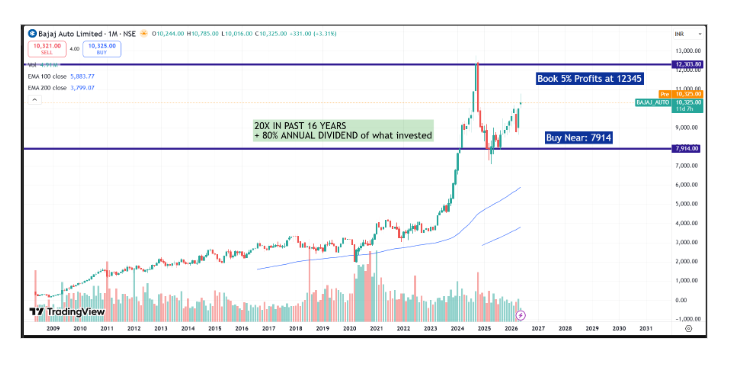
At a CMP of ₹10,607, Bajaj Auto is trading at a premium to historical medians. The market has fully priced in the KTM integration, the ₹150 dividend, and the ₹12,000 buyback floor. The risk-reward ratio is currently balanced, lacking a significant margin of safety.
🔭 The Forward Curve
Looking ahead to H1 FY27 (next two quarters), we project:
Revenue Growth: A normalized 7% to 9% YoY growth, aligning with management's guidance on the broader motorcycle industry's deceleration.
Margin Trajectory: Expect consolidated margins to normalize downward slightly as the ₹1,195 Cr one-time KTM gain phases out, though standalone margins should hold firmly around the ~20% threshold.
🛡️ The Advisory Note
Strategic vs. Tactical Outlook:
🧭 Strategic (Long-Term): Bajaj Auto is no longer just a domestic OEM; it is a global premium mobility holding company. With Chetak scaling rapidly and a highly profitable financing subsidiary, it remains a "Must-Hold" in core automotive portfolios.
🎯 Tactical (Price Opportunity): The imminent ₹5,633 Cr buyback offers downside support, but the stock is fully priced. We advise clients against lump-sum deployments here. Wait for the ex-dividend/ex-buyback dip or any demand-driven market corrections to build fresh positions.
Disclaimer: This report is for educational and informational purposes only. It does not constitute localized financial advice. The authors may hold positions in the securities mentioned.