Bharti Airtel Q4 FY26 Analysis: Strong Operational Momentum vs. ARPU Headwinds
Welcome to our latest Quarterly Results Update. As the 'Elite Equity Research Analyst' at your Corporate Investment Advisory firm, we’ve synthesized the complex financial data and management commentary from Bharti Airtel's Q4 FY26 earnings into actionable insights.
This analysis is designed for our fund clients and students seeking to understand the underlying drivers of Bharti Airtel's performance, balancing the narrative between long-term strategic growth and near-term tactical challenges. Let’s dive into the numbers and what they mean for the investment thesis.
📊 The Snapshot
Note: Financials are based on the Consolidated Income Statement.
✨ The 'Wow' Factor
Here are the standout data points from the quarter that caught our attention:
Milestone Reached: Airtel crossed the 650 million customer mark globally, solidifying its position as the second-largest telco worldwide by customer base.
Africa Value Unlock: The strategic move to increase stake in Airtel Africa by 16.3% via a non-cash share swap (now at ~78%) signals deep conviction in the continent's underpenetrated market.
Dividend Delight: A massive 50% year-on-year increase in the dividend payout to Rs 24 per share, reflecting robust free cash flow generation.
Homes Segment Surge: The Homes business sustained its rapid ascent with a 37.3% YoY revenue growth, driven by a record 1.1 million net customer additions in the quarter.
📈 Operational KPI Table
(Sector-Specific Metrics)
🔍 Financial Deep Dive
Consolidated YoY & QoQ Comparison (Rs in Millions)
*Note: Q4 FY25 PAT included a significant net exceptional gain of Rs 72,868 million.
Cost vs. Efficiency Analysis
Despite the impressive top-line growth, we maintain our critical 'Margin of Safety' mindset regarding costs. Total expenses for Q4 FY26 stood at Rs 238,916 million, up from Rs 231,988 million sequentially. While network operating expenses are growing in line with expansion, we note the management's commentary on cost headwinds, specifically concerning server and memory prices affecting Fixed Wireless Access (FWA) CPE costs. The firm's "war on waste" and the pivot towards fiber (which has a lower long-term cost to serve) are crucial mitigants. The consolidated EBITDA margin expansion (up to 58.4%) suggests that, for now, operating leverage is absorbing these cost pressures effectively.
🎙️ Management Integrity and Tone
Tone: The management team, led by Gopal Vittal, exuded a confident yet realistic tone. There was no sugar-coating the challenges.
Transparency: They were transparent about the sluggish ARPU growth (only +Rs 3 QoQ), directly attributing it to the "broken price architecture" of unlimited 5G plans and external factors like the West Asia crisis impacting roaming revenues.
Defensiveness vs. Objectivity: They avoided direct mud-slinging at competitors when asked about market share gaps, choosing instead to focus on their own internal metrics and the superior economics of their 'fiber-first' strategy.
📉 Key Risks and Red Flags
To maintain objectivity, we must highlight potential risks discussed during the earnings call:
The ARPU Ceiling: Management explicitly stated that the current pricing structure (unlimited 5G) caps ARPU growth. Without an industry-wide tariff hike, organic ARPU expansion will rely solely on premiumization (prepaid to postpaid, 2G to 4G/5G), which may slow down.
Hardware Cost Inflation: Rising chip and memory prices are making FWA deployments significantly more expensive, forcing a pivot back to fiber, which has a longer deployment lead time.
Geopolitical Headwinds: The ongoing West Asia crisis is negatively impacting high-margin international roaming revenues.
Exceptional Items: The company recognized a charge of Rs 31,607 million (consolidated) this quarter due to regulatory and government levies. While described as a re-assessment of existing demands rather than a new issue, these recurring exceptional items warrant scrutiny.
🏢 Peer Benchmarking
While management refrained from naming competitors, the subtext is clear: Airtel is prioritizing value over sheer volume.
Strategy Divergence: While the closest competitor (Jio) has aggressively pushed FWA to capture market share quickly, Airtel is doubling down on FTTH (Fiber-to-the-Home). Airtel argues that while fiber is harder to deploy, it yields the "best type of customer" with significantly lower churn, especially when bundled with mobile services.
ARPU Leadership: Airtel continues to maintain industry-leading ARPU (Rs 257), emphasizing its strategy of portfolio premiumization and targeting high-value customers, even if it means sacrificing some absolute subscriber growth at the bottom of the pyramid.
🔮 The Forward Curve
Based on current run rates and management guidance, we project the following for the next two quarters (Q1 & Q2 FY27):
Revenue: Expect moderate QoQ growth (~1.5% - 2.5%). The absence of a tariff hike means growth will rely on steady subscriber additions and upselling.
EBITDA Margins: Likely to remain stable in the 58%-59% range. The "war on waste" initiatives should offset inflationary pressures on hardware, but significant expansion is unlikely without a price increase.
Capex: Management indicated that overall Capex will remain in the same ballpark as FY26. Expect continued heavy investment in transport (fiber) and data centers, while radio (core wireless) Capex moderates.
⚖️ Valuation Guardrails
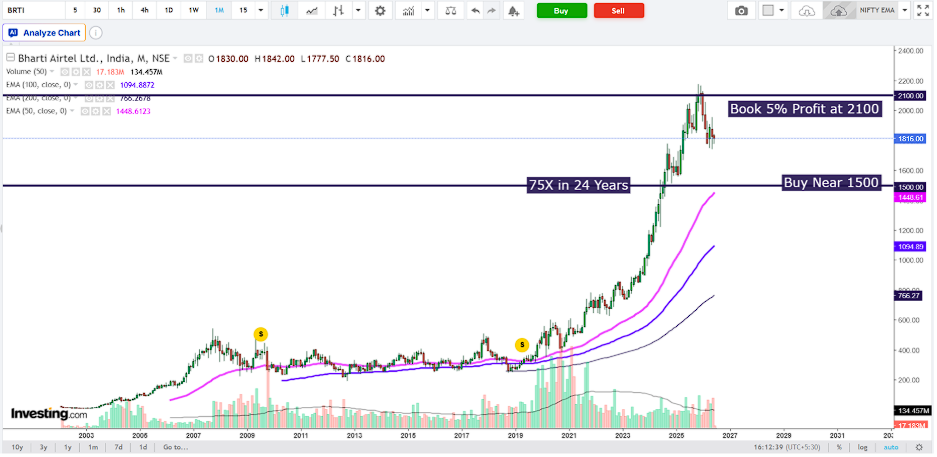
Current Metrics (Approx): Based on the CMP of 1814, Bharti Airtel is trading at a trailing PE of roughly 75x (based on adjusted EPS) and a PB of around 6.5x.
Historical Context: The 5-year median PE is significantly lower, typically hovering around the 40x-50x range (excluding years with anomalous exceptional items).
Verdict: Trading at a Premium. The market is pricing in future tariff hikes, the long-term value of the digital ecosystem (NBFC, Cloud, Data Centers), and the value unlock in Africa. Investors are paying a premium for execution certainty in a duopoly-like structure.
🤝 Shareholding Pattern Highlights
Promoter Stake Strategy: Chairman Sunil Bharti Mittal explicitly stated his desire to see Bharti Telecom (BTL) return to a >50% controlling stake in Bharti Airtel over the next decade.
Singtel Equalization: The recent share swap transaction in Africa (bringing the stake to ~78%) reduces the gap for Singtel to equalize its stake with the Bharti family to just 3.6%.
Future Action: Expect to see increased dividends and potential buybacks used to channel cash up to BTL, enabling it to slowly creep up its ownership in Airtel.
💼 The Advisory Note
Strategic Outlook (Long-Term): The long-term thesis remains exceptionally strong. Airtel is transitioning from a pure telecom operator to a digital platform company. Its investments in data centers, cloud (sovereign cloud focus), and the newly approved NBFC for financial services provide a massive runway for growth. The strategy to deeply penetrate the home broadband market via fiber creates high switching costs and robust customer lifetime value.
Tactical Outlook (Price Opportunity): At Rs 1,814, the stock is priced for perfection. The lack of near-term visibility on a structural tariff hike limits immediate upside catalysts. We advise accumulating on meaningful dips rather than chasing the current momentum, keeping a strict eye on the next two quarters for any changes in the competitive pricing environment.
Financial Disclosure: This report is for informational purposes only and does not constitute investment advice. The analysts or the firm may hold positions in the securities mentioned.