Avenue Supermarts (DMart) Q4 FY26 Analysis: Relentless Expansion vs. Normalizing Margin Efficiencies
By Profit From It Research Desk
Welcome to our quarterly deep dive. Today, we unpack the Q4 FY26 and full-year performance of Avenue Supermarts Limited (DMart). In a retail environment where many are struggling with demand normalization, DMart continues to execute its Everyday Low Cost – Everyday Low Price (EDLC-EDLP) strategy with clinical precision. Let's break down the numbers to see if the underlying fundamentals justify the premium multiples.
📊 The Snapshot
🌟 The 'Wow' Factor
The 500-Store Juggernaut: DMart aggressively expanded its footprint, adding a record 58 stores in Q4 FY26 alone, bringing the FY26 total to 85 new stores and pushing the overall network to exactly 500 stores.
Like-for-Like (LFL) Resurgence: While FY26 LFL growth stood at 8.1%, the metric for two-year and older stores saw a sharp acceleration in Q4 FY26 to 10.8% (up from 8.1% in Q4 FY25), signaling robust footfall recovery.
Revenue Density: Annualized revenue per retail square foot crossed ₹33,422, validating the efficiency of their massive 20.6 million sq. ft. real estate portfolio.
EBITDA Outperformance: Despite the heavy capital expenditure and pre-operating costs associated with opening 58 stores in a single quarter, consolidated $EBITDA$ surged 26.8% YoY.
📈 Operational KPI Table (Retail Core Metrics)
💼 Financial Deep Dive (Consolidated)
YoY & QoQ Comparison
(Note: QoQ declines represent standard seasonality, as Q3 captures the peak Indian festive season).
Cost vs. Efficiency Analysis:
When a retailer opens 58 massive stores in 90 days, you typically expect a severe hit to operating margins due to front-loaded costs. However, we are witnessing the sheer power of DMart's operating leverage. Consolidated $EBITDA$ margins actually expanded by 40 bps YoY to 6.8% (vs 6.4% in Q4 FY25). Management noted a slight improvement in gross margins, while operational costs remained strictly in line with business growth. The strategic pivot in their E-Commerce wing (DMart Ready)—focusing strictly on home delivery and rationalizing operations to 18 core cities—is successfully plugging cash burn. We are maintaining a strict 'Margin of Safety' watch on their General Merchandise & Apparel segment (22.28% of revenue), which typically drives higher margins but remains sensitive to discretionary spending.
🔭 The Forward Curve
Based on management commentary and store vintage maturity, we project revenue growth to comfortably compound at 16%-18% over the next two quarters. The 85 stores added in FY26 will begin to operating at higher utilization rates, driving better fixed-cost absorption. A mild short-term spike in consumer buying due to geopolitical tensions in March has normalized, meaning Q1 FY27 will rely entirely on organic EDLC-driven footfalls.
🛡️ Valuation Guardrails & Shareholding
Valuation Metrics:
Current $\frac{Price}{Earnings}$ (PE): ~88x
5-Year Median PE: ~122x
Current $\frac{Price}{Book}$ (PB): ~11x
Verdict: Historically Discounted (Relatively)
Context: While an 88x multiple is objectively a premium compared to the broader market, DMart has historically commanded astronomical valuations due to its pristine balance sheet and untouchable execution. Trading well below its 5-year median PE offers a relative pocket of value for institutional accumulators.
Shareholding Pattern (As of March 2026):
Promoters: 74.51% (Stable, practically at the SEBI maximum limit of 75%).
FIIs: Increased slightly to 9.00%, showing renewed foreign confidence in Indian domestic consumption.
DIIs: Holding steady at 8.85%.
Pledge: 0% (A flawless corporate governance indicator).
⚖️ The Advisory Note
Strategic vs. Tactical Outlook
Strategic (Long-Term): DMart is the undisputed king of Indian brick-and-mortar grocery retail. Their slow-and-steady cluster-based expansion strategy protects supply chain efficiencies. The milestone of 500 stores is just the beginning in a country with a vast unorganized retail sector.
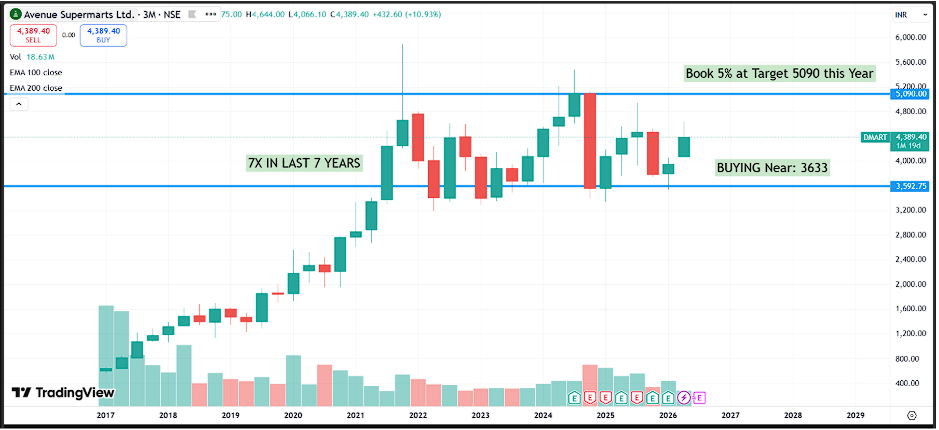
Tactical (Short-Term): At a CMP of ₹4,394, the stock requires patience. While the business is flawless, the valuation leaves zero room for execution errors. We recommend a staggered accumulation strategy, using broader market corrections to build long-term positions.
Mandatory Financial Disclosure: This report is for educational and informational purposes only and does not constitute personalized financial advice. The firm and its analysts may hold positions in the mentioned securities.