Siemens Limited Q5 FY25 Analysis: Structural Tailwinds vs. Capital Allocation Discipline
The Snapshot
The 'Wow' Factor
The Innomotics Slump Sale: Board approved the sale of the Low Voltage Motors (LVM) business to Innomotics India for an Enterprise Value of ₹2,200 crore, streamlining operations and unlocking cash.
Order Book Behemoth: Order backlog stands at a massive ₹42,250 crore ($+6.2\%$ YoY), providing robust revenue visibility across Mobility and Smart Infrastructure.
Structural Streamlining: The Energy business demerger is successfully completed, allowing Siemens Limited to operate as a pure-play automation, digitalization, and smart mobility entity.
Outperforming Peers in Revenue: Delivered a $14\%$ YoY consolidated revenue growth, outpacing closest peer ABB India's $5.7\%$ top-line growth in the identical quarter.
Operational KPI Table
Financial Deep Dive (Consolidated)
Note: Quarter-on-Quarter (QoQ) drops are largely seasonal given the lumpy nature of mobility project recognitions.
Cost vs. Efficiency: Siemens exhibited commendable top-line resilience, yet the bottom line felt the pinch of transitional headwinds. The drop in PAT was largely driven by a non-recurring exceptional charge of ~₹62.8 crore adjusting for the new Labour Codes (gratuity and compensated absences) and a shifting business mix. Furthermore, the Digital Industries (DI) segment continues to be constrained by a strict transfer-pricing framework, keeping its EBIT margins anchored in the 6%8% corridor. Despite these friction points, management’s operational efficiency is evident—leveraging localized manufacturing (e.g., Goa GIS factory) to defend margins against intense competitive bidding.
Management Integrity and Tone
The management's tone during the earnings call was transparent and structurally optimistic. CEO Sunil Mathur highlighted the "Viksit Bharat" macro tailwinds while candidly addressing the current lag in private sector capex. Management did not sugarcoat the margin constraints in the Digital Industries segment (acknowledging it as a transfer-price-regulated business) and was highly pragmatic about capital allocation. Rather than blindly deploying capital, the board demonstrated immense integrity by indefinitely deferring a ₹186 crore capex for a Metro car assembly setup in Aurangabad due to tender delays—proving they prioritize Return on Invested Capital (ROIC) over vanity expansions.
Peer Benchmarking
Compared to its closest competitor, ABB India, Siemens showcased superior top-line execution. For the quarter ended December 2025, ABB India reported a modest $5.7\%$ YoY revenue growth (₹3,557 crore) against Siemens' 14.0% growth. Both engineering giants faced parallel margin compressions stemming from material inflation and the New Labour Code provisions (ABB's net profit also declined 18% YoY). However, Siemens' strategic pivot to solutions-oriented selling (e.g., Virtual PLCs, Chiller optimization for commercial real estate) positions its Smart Infrastructure arm to capture slightly better volume leverage than peers in the medium term.
Key Risks and Red Flags
Metro Capex Deferral: The indefinite postponement of the ₹186 crore Aurangabad metro facility highlights sluggishness in public urban transport tender awards, capping near-term Mobility upside.
Transfer Pricing Constraints: The DI segment's lack of localized manufacturing means it remains heavily dependent on imports from the parent (Siemens AG), strictly limiting margin expansion potential to the single digits.
Private Capex Slumber: While tax and GST cuts are expected to spur consumption, the delayed revival of heavy private capex (steel, cement) remains a drag on the core automation portfolio.
The Forward Curve
We project consolidated revenue to grow at a steady 12%-14% CAGR over the next two quarters. The execution of the mammoth 9,000 HP locomotive order is ramping up on schedule, which will trigger percentage-of-completion (POC) revenue recognition spikes. We expect private capex to begin showing definitive green shoots by the April-June 2026 quarter, post the lag effect of recent consumption-boosting tax reforms.
Valuation Guardrails
Current P/E: 68.5x
5-Year Median P/E: 73.8x
Valuation Status: Historically Discounted
Context: Trading slightly below its 5-year historical premium, the stock offers a reasonable entry point for institutional accumulation, especially given the cleaner balance sheet post the Energy demerger and LVM slump sale.
Shareholding Dynamics
Promoters: Holding remains rock-steady at 75.00%
FIIs: Decreased marginally from 8.8% (Dec 2024) to 6.85% (Dec 2025), reflecting global reallocation.
DIIs: Increased stakes from 7.3% to 4.80% (Mutual funds alone at 3.55%), absorbing the FII outflows and signaling strong domestic institutional confidence.
Pledge: Clean; 0% promoter pledge.
The Advisory Note
Strategic vs. Tactical: Strategically, Siemens is the ultimate proxy to play India's manufacturing renaissance, energy transition, and railway modernization. The portfolio is incredibly well-aligned with the 25% GDP manufacturing target.
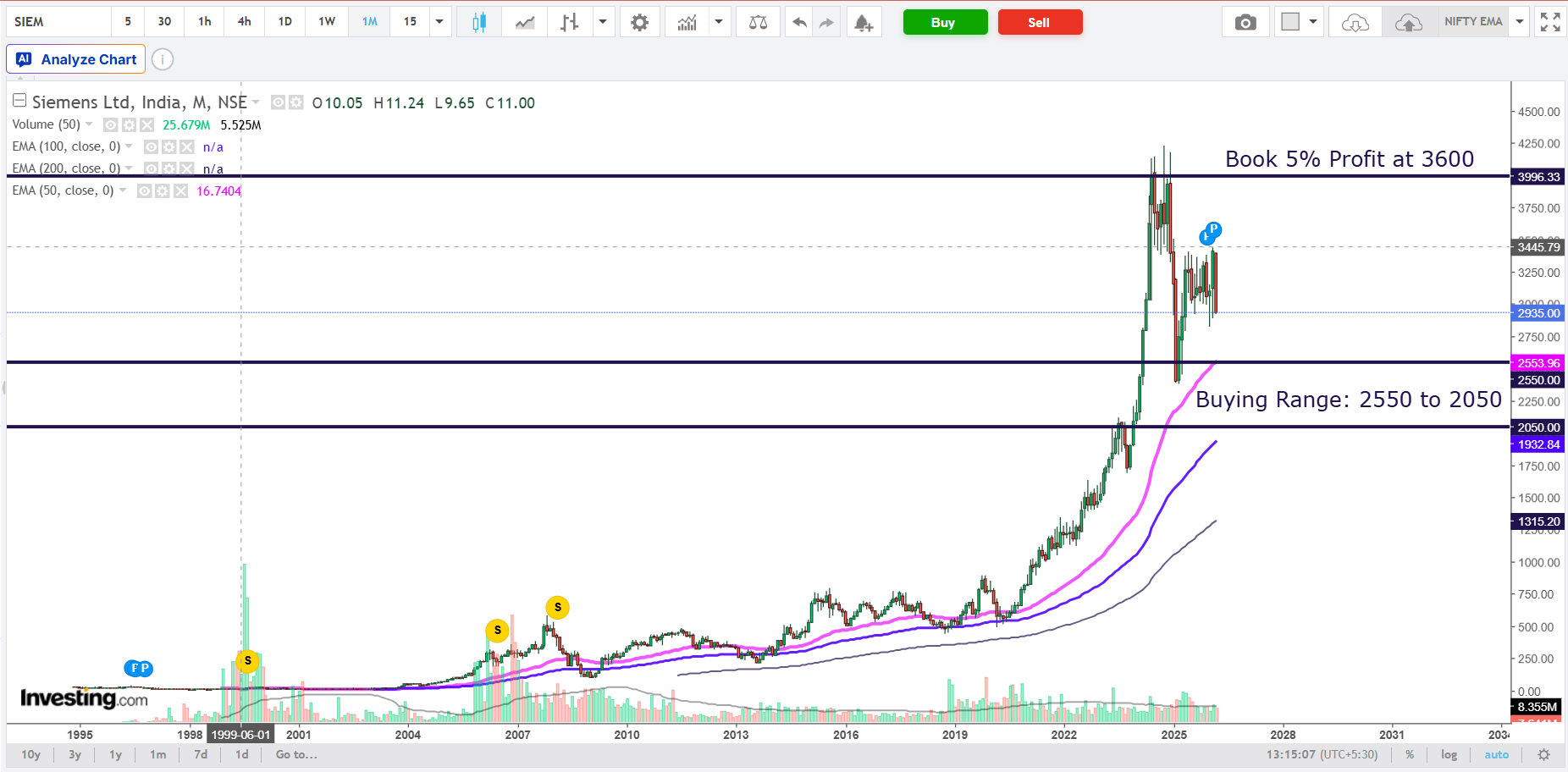
Tactically, the stock might remain range-bound in the near term as the market digests the margin compression and the deferred mobility capex. Use any broader market corrections to accumulate with a "Margin of Safety" mindset.
Financial Disclosure: This report is generated for educational and informational purposes only and does not constitute registered investment advice. Equity investments are subject to market risks.