BSE Limited Q4 FY26 Analysis: Unprecedented F&O Traction vs. Elevated Regulatory Constraints
Published by the ProfitFromIT Research Desk
At our firm, we consistently apply a rigorous 'Margin of Safety' framework to decipher market noise from structural growth. In the latest Q4 FY26 earnings season, BSE Limited has reported numbers that underscore a massive institutional turnaround, driven by a rejuvenated derivatives segment. However, exponential growth often masks underlying structural costs and regulatory overhangs.
Here is our comprehensive analysis of BSE's Q4 FY26 performance, management commentary, and what it means for your portfolio.
The Snapshot
The 'Wow' Factor
Staggering Wealth Creation: Management highlighted a historic scale-up in market capitalization from just ₹5,000 Cr a little over three years ago to over ₹1.56 Lakh Cr today.
Top-line Explosion: Consolidated revenue surged dramatically to ₹1,630 Cr, underscoring the success of their SENSEX and BANKEX options contracts.
Operating Leverage: The exchange achieved a massive $\text{EBITDA}$ margin of ~70%, proving that digital infrastructure models can scale profitably without immediate linear cost hikes.
Operational KPI Table
Note: As an exchange, BSE's true health is measured by liquidity and volume scale.
Financial Deep Dive (Consolidated)
Cost vs. Efficiency Analysis:
While the top-line narrative is euphoric, our 'Margin of Safety' approach requires us to look closely at costs. The jump in $\text{PAT}$ (+61% $\text{YoY}$) and $\text{EBITDA}$ expansion is impressive, showcasing pure operating leverage. However, clearing and settlement charges paid to counterparties, alongside elevated technological spends to handle peak order flows, remain significant margin dampeners. We appreciate management's decision not to leave excess cash idle at 4.5% treasury yields, but rather aggressively deploy capital toward productive uses (such as real estate expansion for their HQ). Still, execution risk on capital allocation is a metric we will be tracking strictly.
Peer Benchmarking: The David vs. Goliath Dynamic
When comparing BSE to its primary, unlisted rival, NSE (National Stock Exchange), the narrative is one of market share reclamation. Historically, NSE commanded an absolute monopoly in the derivatives segment. BSE's strategic move to resize lot sizes and shift expiry days for SENSEX and BANKEX options has allowed it to successfully claw back F&O market share. However, NSE still possesses a much deeper liquidity moat. BSE's current valuation implies it will continue to take market share from NSE seamlessly—an assumption that carries execution risk.
Management Integrity and Tone
Analyzing the Q4 FY26 earnings call transcript, the tone of MD & CEO Sundararaman Ramamurthy was confident, transparent, yet slightly defensive regarding capital allocation.
When questioned by analysts about idle treasury cash and large capital outlays (specifically regarding acquiring a plot of land in Mumbai for expansion), management vigorously defended their strategy. Mr. Ramamurthy was quick to point out the exponential rise in shareholder wealth as validation of their capital deployment strategy. We view the management as highly capable, though the slight defensiveness indicates pressure to justify massive ongoing CapEx during peak growth phases.
Key Risks and Red Flags
To maintain objectivity and protect client capital, we noted the following risks from the earnings call and broader macro environment:
Regulatory Overhang: SEBI's growing discomfort with explosive retail F&O participation could lead to stricter margin requirements, higher lot sizes, or increased taxation. This is a direct threat to BSE's primary growth engine.
Capacity and Tech Resilience: With surging volumes, any technological glitch or system outage could severely damage institutional trust.
Capital Misallocation Risk: The ambitious real estate expansion plans in Mumbai must be monitored closely to ensure they do not become a drag on Return on Equity ($\text{ROE}$).
The Forward Curve
Based on management guidance and current momentum, we project high double-digit $\text{Revenue}$ and $\text{PAT}$ growth to sustain over the next two quarters (Q1 & Q2 FY27). The full realization of revised transaction charges will pad the bottom line, but we model a slight tapering in $\text{QoQ}$ growth as the base effect normalizes and potential regulatory speed bumps emerge.
Valuation Guardrails
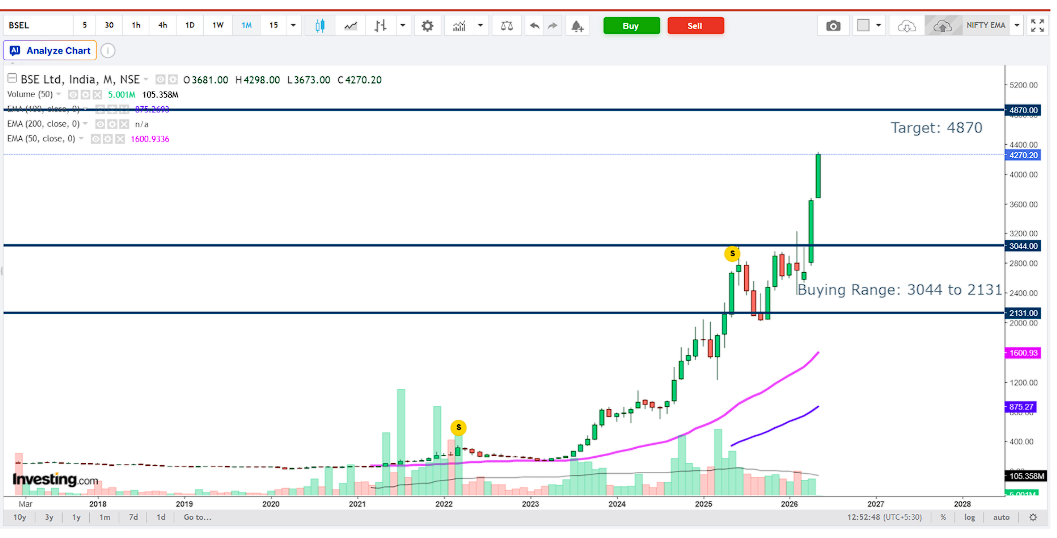
Current Metrics: At a CMP of ₹4,244, BSE is trading at a trailing $\text{P/E}$ of roughly 67x - 75x.
Historical Median: The 5-year median $\text{P/E}$ sits much lower at 44.7x.
Valuation Verdict: Trading at a Premium. While the premium is justified by hyper-growth and market share grabs, there is zero margin for error. Any regulatory shock will compress these multiples rapidly.
Institutional Money Flow (Shareholding Pattern)
Recent data indicates a strong institutional vote of confidence.
FIIs have aggressively increased their stake from 17.45% to 19.42%.
DIIs & Mutual Funds increased their holding to 12.52%.
Retail/Public holds the remaining 55.48%.
Note: BSE is a professionally managed entity with 0% Promoter holding.
The Advisory Note
Strategic Outlook (Long-Term Thesis): BSE is no longer a dormant legacy exchange; it is a highly agile, compounding machine taking structural market share in India's booming financialization theme. For long-term investors, this remains a core portfolio candidate.
Tactical Outlook (Price Opportunity): At a $\text{P/E}$ of 70x+, the stock is priced for perfection. We advise against lumpsum buying at current levels (₹4,244). We recommend initiating or adding to positions during broader market corrections, ideally waiting for a 15-20% technical pullback to build a margin of safety.
Disclaimer: This research piece is for educational and informational purposes only. It does not constitute localized financial advice. Equity investments are subject to market risks;