Reliance Industries Q4 FY26 Analysis: Telecom & Retail Resilience vs. O2C Margin Headwinds
By the Profit from It Equity Research Desk
As value-oriented analysts, we approach every earnings season with a strict 'Margin of Safety' mindset. Reliance Industries Limited (RIL), a true bellwether of the Indian markets, just posted its Q4 FY26 results. While the top line hit record highs, the bottom line painted a picture of margin compression amid complex macroeconomic realities. Here is our comprehensive deep dive into RIL’s Q4 FY26 performance, stripping away the noise to help our fund clients and students of the market make informed decisions.
The Snapshot
The 'Wow' Factor
While profitability faced headwinds, the sheer scale of RIL's operational machinery delivered some formidable milestones this quarter:
Record Consolidated Revenue: Gross revenue scaled to an all-time high of ₹ 11.75 lakh crore for the full year FY26, proving the structural growth of its consumer businesses.
Jio's Scale: The telecom arm crossed a staggering 524 million subscribers, boasting 66 Exabytes of quarterly data traffic (up 35% YoY) and solidifying its global dominance.
Green Energy Traction: RIL is aggressively moving toward its 100 GWh battery manufacturing capacity target, with the first 40 GWh phase on track for commissioning this year.
Consistent Capital Return: Despite a dip in quarterly net profit, the board maintained shareholder commitment with a ₹ 6/share dividend.
Operational KPI Table
To understand a conglomerate, we must look at sector-specific operating metrics rather than generic ratios.
Financial Deep Dive: Consolidated Performance
Let’s look at the hard numbers. Note that all figures are on a consolidated basis.
Cost vs. Efficiency: The Margin Paradox
This quarter epitomizes a divergence between revenue expansion and margin reality. The $12.8\%$ YoY jump in revenue was entirely overshadowed by a $12.5\%$ drop in $\text{PAT}$. Why? Because growth is currently expensive for Reliance. Our cost analysis indicates that EBITDA margins shrank by roughly 200 bps to $14.9\%$. The O2C segment is battling volatile crude costs and weak global refining margins. Concurrently, massive capex allocations toward the New Energy gigafactories and retail quick-commerce expansion are adding heavy depreciation and operational overheads. It is classic delayed gratification: costs are front-loaded, while efficiencies and cash flows from these new ventures remain quarters away.
Management Integrity and Tone
Analyzing the earnings call transcript, Chairman Mukesh Ambani’s tone can be categorized as transparent and pragmatically confident.
Management didn't shy away from external realities, openly citing "geopolitical disruptions, volatile energy prices, and shifting global trade patterns." This lack of defensiveness builds trust. Importantly, their narrative aggressively pivoted to India’s domestic resilience and the structural cushion provided by their consumer businesses (Jio and Retail), which now contribute over 55% of the consolidated $\text{EBITDA}$.
Key Risks & Red Flags Mentioned:
Global refining margin compression remaining a threat to O2C profitability.
The massive ₹ 75,000 crore capex overhang for New Energy operations suppressing near-term free cash flow (FCF).
Shareholding Nuances: Follow the Smart Money
A critical factor for our institutional clients is the shifting sands of institutional ownership.
FII Selling: Foreign Institutional Investor (FII) holding has systematically declined, sitting at just 18.67% at the close of FY26 (down sharply from ~28% in 2021).
Promoter Confidence: Conversely, the Promoter group has maintained an absolute, rock-solid holding at 45.43%, with exactly 0% of shares pledged. This zero-pledge status acts as a massive governance safety net during turbulent market cycles.
The Forward Curve
Looking at the next two quarters (Q1 and Q2 FY27), we expect:
Jio IPO Visibility: With Ambani hinting that the Jio IPO plan is "on track," expect immense value-unlocking speculation to act as a floor for the stock price.
O2C Stabilization: If Middle East tensions normalize, a mild reversion to the mean for refining spreads could add an immediate $\text{EBITDA}$ kicker.
Capex Translation: We will closely monitor the operationalization of the 40 GWh battery manufacturing plant.
Valuation Guardrails
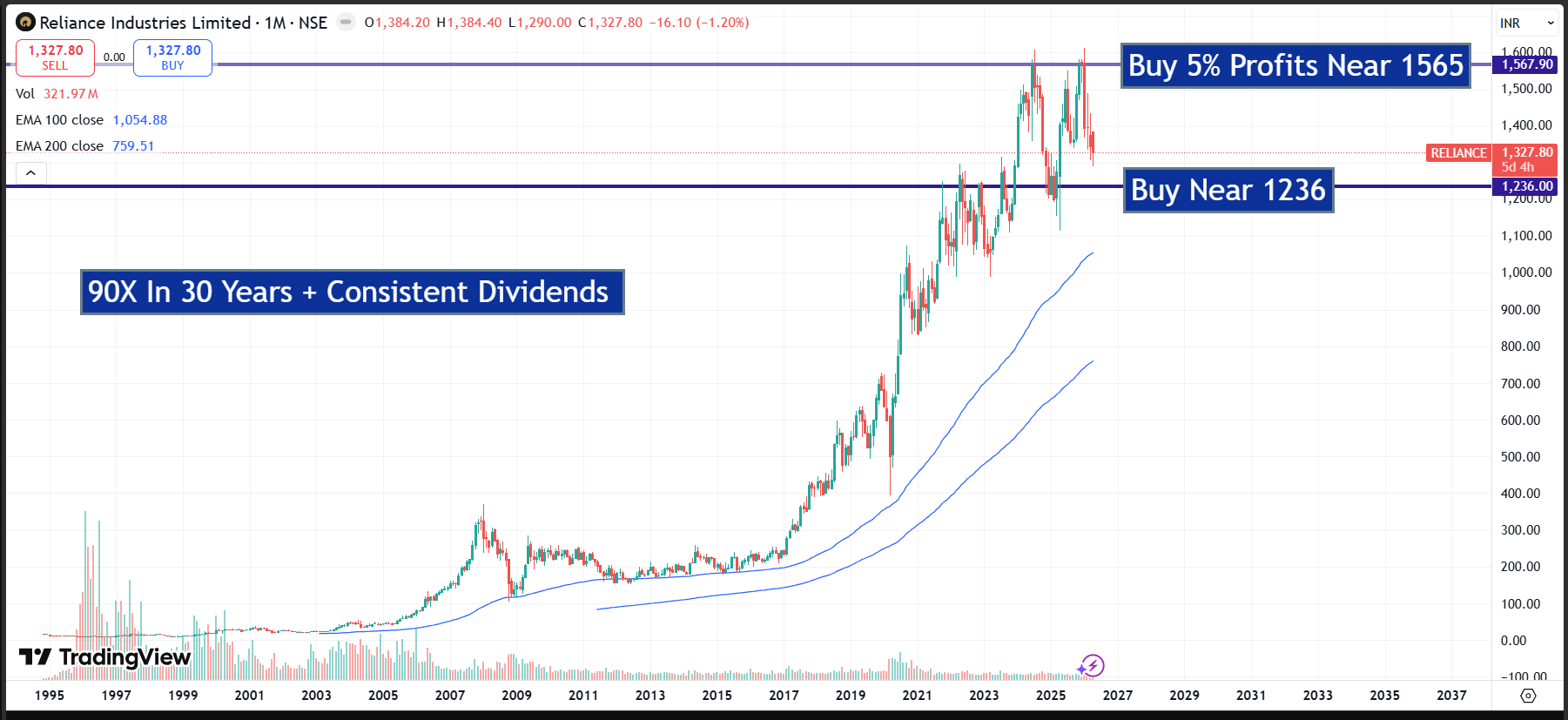
Current Metrics: At a CMP of ₹ 1,328, RIL is trading at a $\text{P/E}$ of $21.6\times$ and a $\text{P/B}$ of $1.8\times$.
5-Year Benchmarking: The historical 5-year median $\text{P/E}$ hovers closer to the $22\times - 24\times$ range.
Valuation Verdict: Fairly Valued. The stock is currently trading closely in line with historical averages. While the core businesses (Retail/Telecom) deserve a premium, the near-term drag from O2C cyclicality and New Energy capex perfectly balances the scale.
The Advisory Note
Strategic Outlook: Over a 3–5 year horizon, RIL's transition from a legacy petrochemical giant to a global leader in Digital, Retail, and Green Energy is fully intact. It remains a core portfolio compounder.
Tactical Outlook: In the short term, sideways movement is highly probable as the market digests the capex load and flat EBITDA. Wait for macro-driven dips closer to the ₹ 1,200 - ₹ 1,250 range to build long-term positions with a true Margin of Safety.
Financial Disclosure: This report is for educational and informational purposes only and does not constitute registered financial advice. The analyst and the firm may hold positions in the aforementioned securities.