State Bank of India (SBIN) Q4 FY26 Analysis: Historic Asset Quality vs. Unrelenting Margin Pressures
By Profit From It Research | Corporate Investment Advisory
State Bank of India (SBI) has once again demonstrated why it remains the sovereign anchor of India's banking sector. While the Q4 FY26 print showcased record-breaking annual profitability and pristine asset quality, the street's reaction was muted. As value investors and analysts, we must look beyond the headline numbers to dissect the core operational engine of the bank. Today, we break down SBI's latest earnings, peer benchmarking, and management's tone to evaluate if the stock offers an adequate margin of safety.
The Snapshot: Q4 FY26 (Consolidated)
The 'Wow' Factor: Key Surprises
Historic Profitability Milestone: SBI reported a record annual net profit crossing the ₹80,000 crore mark for the first time in its history (FY26), solidifying its absolute earnings dominance.
Asset Quality Nirvana: Gross Non-Performing Assets (GNPA) tumbled to a multi-year low of 1.49% (down 33 bps YoY). The era of heavy corporate NPA baggage is decisively behind them.
Retail Engine Roars: Domestic Retail Personal loans grew by an impressive 15.22% YoY, crossing ₹17.35 Lakh Crore, with Home Loans growing steadily at 13.66%.
Operational KPI Table
For banks, the balance sheet tells the true story. Here is how SBI's core engine performed this quarter:
Financial Deep Dive (Consolidated)
Note: The following table represents consolidated financials to capture the full picture of SBI's subsidiaries (Life Insurance, Mutual Funds, Cards, etc.).
Cost vs. Efficiency Analysis
While the Net Profit (PAT) beat estimates, the core Operating Profit saw an 11.45% YoY decline. This is the primary reason the stock faced pressure post-earnings. The decline is rooted in two factors: unrelenting wage provisions and a sharp reversal in treasury income (booking a ₹1,471 crore loss versus a ₹6,879 crore profit last year). The cost-to-income ratio remains elevated. However, as disciplined analysts, we note that lower operating profits were cleverly offset by drastically reduced credit costs (provisions for bad loans), leading to a higher PAT. Going forward, the bank must demonstrate operating leverage without relying entirely on provision write-backs.
Peer Benchmarking & Management Tone
Management Integrity and Tone: During the earnings call, management's tone was confident yet transparent. They did not shy away from addressing the margin compression. When questioned about yields, management frankly acknowledged that prime AAA-rated corporates shifting from capital markets back to bank credit has altered their loan composition, structurally impacting yields but improving overall portfolio safety. We appreciate this transparency; it builds long-term institutional trust.
Peer Benchmarking:
Compared to its closest private peer, HDFC Bank, SBI is heavily outperforming on the deposit growth front but lagging slightly in NIMs. While HDFC Bank is grappling with elevated credit-deposit (CD) ratios post-merger, SBI's vast branch network ensures an organic, sticky deposit base, granting them superior liquidity flexibility.
Shareholding Pattern Shifts
Promoter: The Government of India holds steady at 55.52%. (No pledge issues).
FII/FPI: Foreign Institutional Investors showed significant confidence, increasing their stake from 10.34% in Q3 to 11.41% in Q4 FY26.
DII: Domestic Mutual Funds marginally trimmed their exposure from 13.76% to 13.29% to balance portfolio weights post the stock's recent run-up.
Public: Retail holding sits comfortably low at 6.82%, indicating the stock is tightly held by strong hands.
Valuation Guardrails
To evaluate SBI, we use standard banking valuation metrics, primarily Price-to-Earnings ($P/E = \frac{\text{Market Price}}{\text{Earnings Per Share}}$) and Price-to-Book ($P/B = \frac{\text{Market Price}}{\text{Book Value Per Share}}$).
Current P/E: 10.7x (vs. 5-year median of 10.9x)
Current P/B: 1.56x (vs. 5-year median of 1.50x)
Valuation Verdict: Fairly Valued to Slightly Premium. While SBI is trading slightly above its 5-year historical P/B median, we must factor in that its ROE (Return on Equity) has expanded to ~15%. At 1.56x P/B, SBI still trades at a massive structural discount to private peers (ICICI at ~3.2x, HDFC at ~2.8x).
The Forward Curve (Next 2 Quarters Outlook)
Looking at guidance and macro-economic factors, we project:
Q1 FY27: NIMs will likely bottom out around the 2.75% - 2.80% mark as deposit repricing fully peaks.
Q2 FY27: Operating profit margins should begin to normalize as treasury losses stabilize and the new RBI rate cycle provides clarity. Loan growth is expected to remain resilient at 13-14% YoY.
The Advisory Note
Strategic (Long-Term) Thesis: SBI is no longer a bloated PSU; it is a highly efficient retail and corporate lending machine. For fund clients looking for a stable compounder with a secure dividend yield (~1.8%), SBI remains a core portfolio anchor.
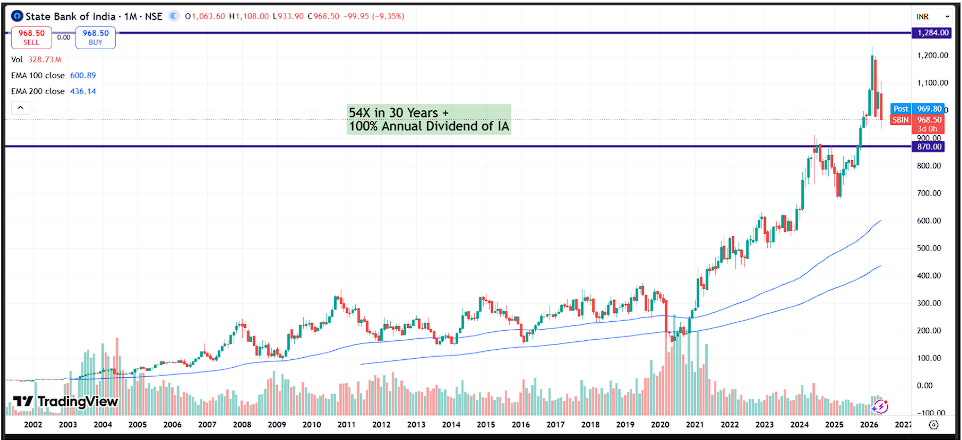
Tactical (Short-Term) Price Opportunity: The recent 6-7% correction post-earnings (driven by NIM compression) has built a reasonable Margin of Safety. Accumulating near the ₹900 - ₹940 zone offers an excellent risk-reward ratio for a target of ₹1,150+ over the next 18 months.
Disclaimer: This report is for educational and informational purposes only. The Elite Equity Research firm and its analysts may hold positions in the aforementioned securities.