Vedant Fashions Limited Q4 FY26 Analysis: Margin Resilience vs. Sluggish Store Expansion
In the high-stakes world of branded retail, few stories are as compelling as the journey of Indian celebration wear. As the flagship player in this niche, Vedant Fashions Limited (Manyavar) released its audited financial results for Q4 FY26 and the full fiscal year ended March 31, 2026.
While the headline annual numbers reflect a year of transitional consolidation under macroeconomic pressure, the final quarter of the year (Q4 FY26) signals a vital operational recovery. In this deep-dive blog post, we strip away the corporate accounting jargon to evaluate whether Manyavar's premium business model remains structurally intact or if near-term headwinds are creating permanent cracks in its moat.
📊 The Snapshot
⚡ The 'Wow' Factor: Key Outliers & Data Points
Before diving into the spreadsheets, here are the most impactful and surprising takeaways from Vedant Fashions' FY26 performance:
Flagship Milestone: The flagship brand Manyavar officially crossed the ₹2,000 Crore milestone in customer retail sales, closing FY26 at ₹2,008 Crore ($\approx 6.1\%$ YoY growth).
Exceptional Cash Generation: Despite softer profitability, the company achieved an outstanding cash conversion ratio of ~98% (Operating Cash Flow to PAT, excluding finance income). Consolidated Operating Cash Flow grew 23.9% YoY to ₹481.4 Crore.
Store Rationalization over Aggressive Land Grabs: Demonstrating intense fiscal discipline, Vedant Fashions added only 4,200 sq. ft. (net) to its retail footprint in FY26. Management intentionally shut down underperforming locations to preserve unit economics in a hyper-inflated commercial rental market.
Generous Capital Return: The Board recommended a final dividend of ₹7.75 per share for FY26 (a $775\%$ payout on face value of Re 1), demonstrating management's confidence in its asset-light franchise model's cash generation capabilities.
📈 Operational KPI Dashboard
To truly understand an ethnic retail powerhouse, we must look beyond standard accounting metrics and focus on specialized operational KPIs:
Note: SSSG represents the true organ of organic growth. The rebound of SSSG to $4.6\%$ in Q4 FY26 indicates that demand is returning to premium brick-and-mortar storefronts after a soft middle-quarter cycle.
🔍 Financial Deep Dive (Consolidated Income Statement)
A rigorous year-over-year (YoY) and quarter-over-quarter (QoQ) consolidated review highlights a classic operational divergence:
Cost vs. Efficiency Analysis
At first glance, the full-year margin compression (EBITDA margin down 230 bps; PAT margin down 180 bps) raises questions. However, a closer look reveals that this was largely a structural tax artifact rather than operational inefficiency. The GST rate hike implemented in late 2025 created a permanent step-up in tax costs, compressing the consolidated gross margin from $67.2\%$ to $65.7\%$.
$$\text{Gross Margin} = \frac{\text{Gross Profit}}{\text{Revenue from Operations}} \times 100$$
Despite this tax headwind and high inflation in raw materials, Vedant Fashions demonstrated world-class operating resilience in Q4 FY26. EBITDA margins expanded 50 bps YoY to $45.6\%$, and PAT margins grew by 110 bps YoY to $28.6\%$. The company avoided the trap of aggressive end-of-season discounting, maintaining strict pricing integrity.
⚖️ Peer Benchmarking: Manyavar vs. Kewal Kiran Clothing (KKCL)
To appreciate the business model's strength, we compare Vedant Fashions against Kewal Kiran Clothing Limited (KKCL), an organized apparel powerhouse that also released its FY26 figures.
Revenue Growth Trajectory: KKCL achieved a stellar FY26 revenue growth of $20.9\%$ (reaching ₹1,212.8 Cr), largely driven by casual wear, denim, and its Kraus Casuals acquisition. In contrast, Vedant's revenue growth was a conservative $3.5\%$ (at ₹1,435.5 Cr).
The Margin Discrepancy: While KKCL excels at high-volume distribution, its EBITDA margins stood at $19.6\%$ for FY26. Vedant Fashions operates in a completely different financial orbit, registering an EBITDA margin of $44.3\%$ ($\approx 2.25 \times$ higher than KKCL).
Capital Efficiency Moat: Vedant Fashions' premium pricing and exclusive brand positioning allow it to convert $26.2\%$ of its operational revenue straight into net profit (PAT). KKCL, while highly efficient in casual wear, generated a PAT margin of $12.3\%$ in FY26.
This benchmark proves that while casual wear peers can generate faster short-term volume expansion, Vedant's ethnic portfolio holds an unmatched, fortress-like gross margin profile ($65.7\%$ vs KKCL's $42.2\%$) that protects it against down-cycles.
🛠️ Management Integrity & Tone
The tone of the Q4 FY26 earnings call was transparent, realistic, and highly long-term focused.
Management was remarkably candid about the soft consumer discretionary demand environment over the past two years. Rather than resorting to artificial stimulants—such as heavy promotional schemes or bulk liquidation through secondary channels—they chose to stand their ground.
"Even though times are tough, we are able to stand our ground and not make any decisions that we feel will be wrong for the long term... We, as a Company, have that mindset of sticking towards making decisions that only help us grow from a long-term perspective."
This defensive stance to protect brand equity, even if it meant absorbing a slight decline in annual net profit, showcases exemplary stewardship.
⚠️ Key Risks & Red Flags
An objective "Margin of Safety" analysis requires us to highlight structural concerns:
Working Capital Expansion: A major red flag is the significant rise in working capital cycles. Working capital days surged from 162 days to 254 days, alongside high debtors standing at 166 days. This indicates that franchise channels are taking longer to clear stock and pay the parent company, which must be monitored closely in FY27.
High Real Estate Rentals: The sluggish store network growth is a symptom of an expensive commercial real estate market. Expanding in high-rent locations without guaranteed footfalls would destroy store-level EBITDA. Management is stuck in a low-growth loop until rental inflation cools.
Severe Seasonality Risk: The company's financials remain highly sensitive to the Hindu marriage calendar. Negligible wedding dates in Q1 FY26 severely hurt the first half, making the company vulnerable to calendar volatility.
📈 The Forward Curve (Outlook for Q1 & Q2 FY27)
Guidance Synthesis: Management is pivoting away from aggressive physical expansion to focus on three key organic drivers: Same-Store Sales Growth (SSSG), upgrading product Average Selling Price (ASP) through premium merchandising, and targeted reactivation of their massive database of 90 lakh registered customers using AI-based marketing.
Projections: With a normalized wedding calendar returning in H1 FY27 and a very low base in Q1 FY26, we project a strong sequential and YoY operational recovery.
We estimate:
Q1 FY27 Revenue Projection: ₹295 – ₹310 Crore ($\approx +5\%$ to $+10\%$ YoY)
Q2 FY27 Revenue Projection: ₹285 – ₹295 Crore ($\approx +8\%$ to $+12\%$ YoY)
EBITDA Margin Stabilization: Projected to hold steady between $43.5\%$ and $45\%$ as GST rate changes are now fully absorbed into pricing.
🛡️ Valuation Guardrails
To evaluate the entry point, we compare Manyavar's current valuation multiples against its historical median since listing:
$$\text{P/E Ratio} = \frac{\text{Current Market Price (CMP)}}{\text{Earnings Per Share (EPS)}} = \frac{419}{15.46} \approx 27.1\text{x}$$
Historical PE Context: Historically, Vedant Fashions traded at steep premium valuations, with its PE multiple averaging 48.5x in FY25, 54.4x in FY24, and peaking over 74x in FY22-23.
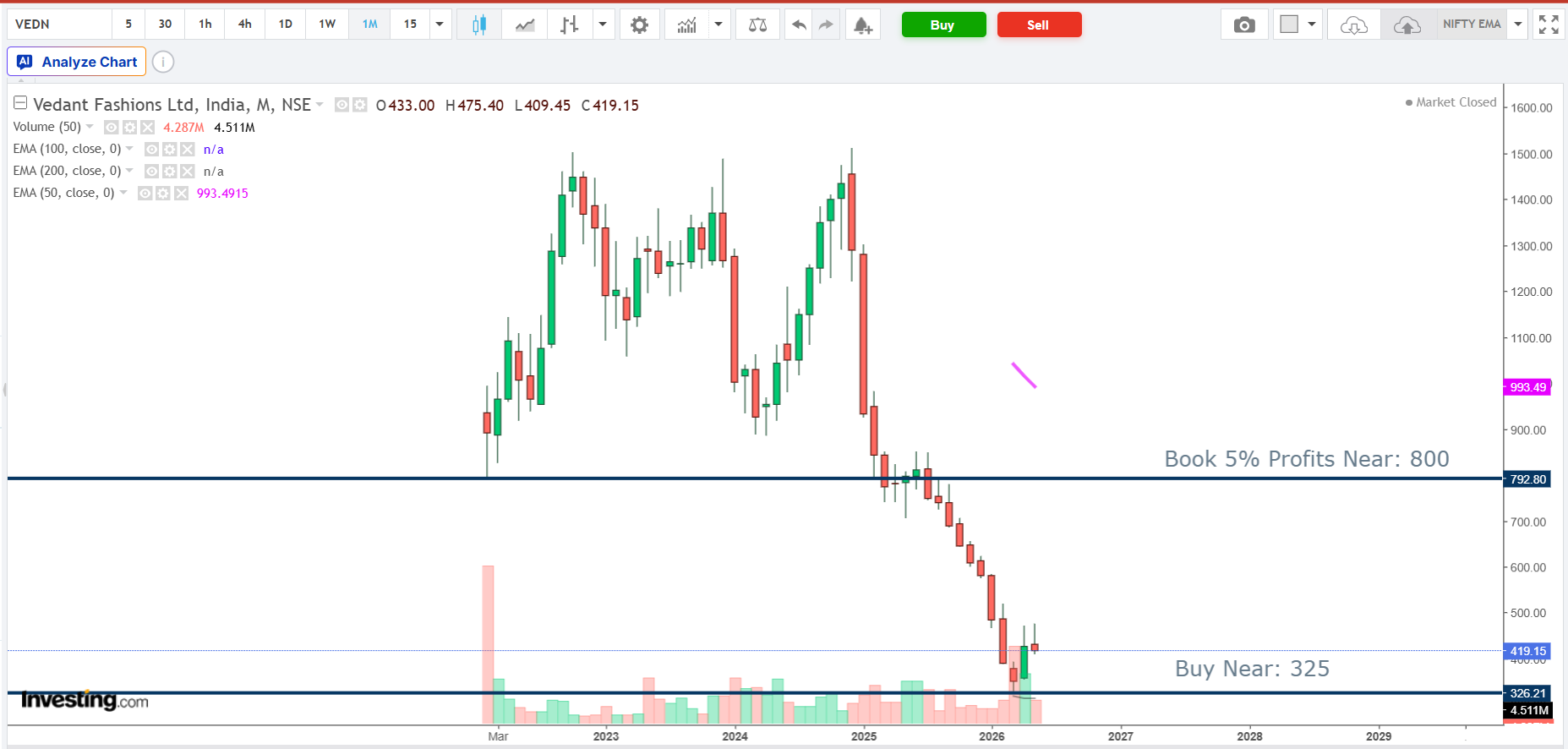
Historical PB Context: At CMP ₹419, the P/B ratio stands at ~5.1x, compared to a historical median of ~14.1x.
Valuation Verdict: Historically Discounted. The stock has corrected more than $43\%$ over the last year. At $\approx 27.1\text{x}$ trailing earnings, the market has completely de-rated the stock due to temporary macro pain, presenting an excellent valuation cushion for long-term investors.
🔑 Shareholding Insights
Understanding who owns the business is crucial:
Promoters' Stake: $74.94\%$ (No change. This is virtually at the maximum statutory limit of $75\%$, indicating absolute skin in the game).
Pledge Check: $0.00\%$ (There are zero promoter shares pledged, eliminating any leverage risks).
Institutional Support: FIIs hold $8.28\%$ and Mutual Funds hold $10.02\%$ of the equity. Over the last three quarters, FII holdings saw minor profit-taking due to general macro outflows, while domestic mutual funds have absorbed the supply, reflecting robust domestic institutional trust.
🏛️ The Advisory Note
Strategic Outlook (Long-Term Thesis)
The long-term investment thesis for Vedant Fashions remains highly robust. The company possesses an asset-light, franchisee-owned-and-operated (FOFO) model that enjoys massive operating leverage. By commanding a gross margin profile of $65\%+$, it behaves more like a luxury brand than a traditional retail business. Once consumption cycles recover and the wedding calendar normalizes, this high gross-to-net-profit conversion engine will easily drive double-digit earnings growth.
Tactical Outlook (Near-Term Opportunity)
Tactically, the stock is currently in an accumulation zone. Having faced massive selling pressure, the stock's downside seems limited by its strong dividend support (proposed ₹7.75 dividend yielding $\approx 1.85\%$ at CMP) and historically discounted PE multiple of 27x. We advise clients to scale into the stock incrementally over the next two quarters, utilizing any macro-driven volatility to build a core position.
📢 FairValue:
https://docs.google.com/spreadsheets/d/e/2PACX-1vQlPy-GyaseTK1kUyhtrlhuBA6sobQV6gw8c6OucVey11AYVvn1abJNvlZgyKYP2ukr1kT7IDTd5Fs7/pubhtml?gid=182169784&single=true
📢 Mandatory Disclosure
This report is for educational and informational purposes only and does not constitute formal personal investment advice. Vedant Fashions Limited is subject to market risks, and investors are urged to read all financial disclosures before making any allocation decisions.