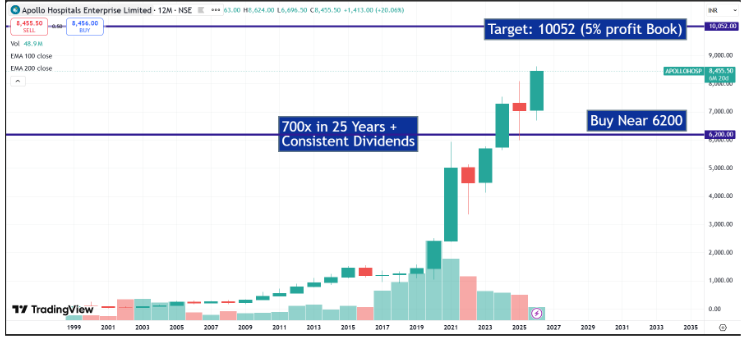
Apollo Hospitals Enterprise Ltd (APOLLOHOSP) Q4 FY26 Analysis: Robust Healthcare Services Growth vs. Digital Integration and Bed Expansion Costs
Executive Summary & Investment Thesis
Apollo Hospitals Enterprise Ltd (AHEL) delivered a stellar operating performance in Q4 FY26, driven by a powerful operational turnaround in its digital health platform (Apollo HealthCo) and robust operating leverage within its core Healthcare Services (Hospitals) and retail healthcare (AHLL) verticals.
As elite corporate investment advisors, our analysis indicates that AHEL is successfully executing its transition from a high-investment, growth-at-all-costs digital model to an integrated, highly profitable, and capital-efficient omnichannel healthcare platform. While the core hospital business remains the cash cow, the material reduction in digital cash losses and the strategic asset monetisation of the maternity/fertility division represent significant triggers for long-term compounding.
The Snapshot
The "Wow" Factor: Impactful Takeaways
Digital Cash Losses Evaporated: Apollo HealthCo's digital health platform (Apollo 24/7) saw its digital cash losses contract dramatically to just ₹16 Crore ($\text{INR } 160 \text{ Million}$) in Q4 FY26, down from a painful ₹80 Crore ($\text{INR } 800 \text{ Million}$) in Q4 FY25. This $\approx 80\%$ reduction in burn brings the digital vertical to the cusp of operational breakeven.
Significant Asset Monetisation: AHEL announced the divestment of its diagnostics/specialty subsidiary AHLL’s fertility and specialty maternity assets into Cloudnine (Kids Clinic India Ltd) at an enterprise value of ₹1,550 Crore. This transaction will yield AHEL ₹765 Crore in cash and a $9.9\%$ strategic equity stake in the combined maternity powerhouse, unlocking immense shareholder value.
Core Hospital Margin Peak: Established hospitals recorded an outstanding operating EBITDA margin of $25.5\%$ in Q4 FY26, demonstrating substantial pricing power and excellent cost control.
De-risking the Balance Sheet: Promoters’ pledged shares dropped drastically from $13.47\%$ in March 2025 to just $2.49\%$ in March 2026, removing a massive overhang and enhancing institutional confidence.
Operational KPI Table
To provide a granular look at the hospital’s core performance, we evaluate sector-specific metrics. Note that management has replaced the legacy ARPOB (Average Revenue Per Occupied Bed) with ARPP (Average Revenue Per Patient) to better capture realization gains from shorter hospital stays.
Financial Deep Dive: Consolidated Income Statement
All figures are in INR Crore and represent consolidated performance (including hospitals, HealthCo, and AHLL).
Cost vs. Efficiency Analysis
We must evaluate margins critically to ensure growth is sustainable. AHEL’s consolidated EBITDA grew by $31.30\%$ YoY in Q4 FY26, substantially outpacing its $18.12\%$ top-line growth. This operating leverage is modeled mathematically as:
$$\text{EBITDA Margin Expansion} = \left(\frac{\text{EBITDA}_{\text{Q4FY26}}}{\text{Revenue}_{\text{Q4FY26}}}\right) - \left(\frac{\text{EBITDA}_{\text{Q4FY25}}}{\text{Revenue}_{\text{Q4FY25}}}\right) = 15.31\% - 13.76\% = +1.55\% \text{ (155 bps)}$$
This expansion was achieved through two primary drivers:
Clinical Specialisation Intensity: The revenue share of complex surgical specialties (Cardiac, Oncology, Neuro, Ortho, and Gastro - collectively called CONGO) surged. Cardiac sciences grew by $19\%$ and orthopedics by $20\%$ YoY in Q4.
Fixed Cost Optimisation: Despite a sequential rise in employee benefits expense to ₹441.20 Crore (up from ₹410.10 Crore in Q3), established hospital units achieved scale efficiencies. Meanwhile, new hospital operational losses stood at ₹41 Crore, which represents a well-managed drag.
The Forward Curve: Projections & Guidance
Management has provided a clear roadmap for the medium term:
Bed Expansion Pipeline: AHEL plans to operationalise $1,400$ beds over the next $12 \text{ to } 18 \text{ months}$ in high-demand Tier-1 cities (Gurugram, Bengaluru, Pune, and Hyderabad) with an expected internal rate of return (IRR) of $15-17\%$.
HealthCo Profitability Guidance: Management reiterated that Apollo HealthCo is on track to exit FY27 with a pro-forma revenue run-rate of ₹25,000 Crore and an EBITDA margin of $6.5-7.0\%$ (compared to $\approx 4.3\%$ in FY26), driven by the digital breakeven and supply-chain synergies with Keimed.
New Hospital Losses: Guidance of ₹140-150 Crore in pre-operating/start-up EBITDA losses for FY27 as new blocks are commissioned.
Quarter-on-Quarter Growth Projections
Based on management's 14% revenue CAGR guidance over FY26-FY28, we project the consolidated numbers for the next two quarters:
$$\text{Projected Revenue}_{\text{Q1FY27}} = \text{Revenue}_{\text{Q1FY26}} \times (1 + g) = 5,842 \times 1.135 = \text{INR } 6,630 \text{ Crore}$$
$$\text{Projected Revenue}_{\text{Q2FY27}} = \text{Revenue}_{\text{Q2FY26}} \times (1 + g) = 6,304 \times 1.135 = \text{INR } 7,155 \text{ Crore}$$
Valuation Guardrails
To determine if AHEL has a margin of safety, we compare its current multiples against historical benchmarks.
Price-to-Earnings (P/E) Multiple:
Current TTM P/E: $62.81\text{x}$ (based on CMP ₹8,482 and TTM EPS of ₹135.04)
5-Year Median P/E: $72.60\text{x}$
Verdict: Historically Discounted on an earnings basis. Despite the recent stock price rally, strong PAT growth ($+34.29\%$ in FY26) has caused the multiple to contract, making it cheaper relative to its historical premium.
Price-to-Book (P/B) Multiple:
Current P/B: $12.24\text{x}$ to $12.88\text{x}$
5-Year Median P/B: $11.58\text{x}$
Verdict: Trading at a Minor Premium to book value, reflecting AHEL's superior ROE of $22.1\%$ which stands significantly above its 5-year average of $16.9\%$.
Shareholding Pattern Dynamics
AHEL's share ownership shows a strong institutional holding structure:
Promoters: Holding remained completely stable at $28.02\%$ in the March 2026 quarter.
Promoter Pledge: Remained unchanged at a low of $2.49\%$, down dramatically from $13.47\%$ in March 2025. This indicates a major mitigation of default and forced selling risk.
Foreign Institutional Investors (FIIs): Slipped slightly from $43.54\%$ in Dec 2025 to $42.62\%$ in March 2026 (net exit of $92 \text{ bps}$), as part of a broader macro emerging-market allocation shift.
Domestic Institutional Investors (DIIs): Rose from $21.50\%$ in Dec 2025 to $22.76\%$ in March 2026 (net accretion of $126 \text{ bps}$), led by insurance companies accumulating quality defensive assets.
The Advisory Note: Strategic vs. Tactical Outlook
The Strategic Thesis (Long-Term Compounding)
We believe Apollo Hospitals remains a core "buy-and-hold" compounder in the Indian healthcare landscape. The company's moat is built on two pillars: clinical dominance in premium medical specialties and a highly scalable, digital patient acquisition funnel. By spinning off and demerging Apollo HealthCo by Q4 FY27, management will unlock deep value, eliminating the digital margin drag on the asset-heavy hospital business. The steady reduction in promoter pledge and strong ROE execution ($>22\%$) confirm top-tier corporate governance.
The Tactical Outlook (Near-Term Price Opportunity)
In the short term, any price corrections arising from macro headwinds (such as geopolitical tensions impacting foreign patient volumes from Bangladesh or temporary start-up losses of ₹140 Crore in FY27) should be viewed as excellent buying opportunities. Strong technical support is established at ₹8,000, with an institutional price target of ₹9,610, implying an upside of $+13.3\%$.
FairValue: https://docs.google.com/spreadsheets/d/e/2PACX-1vQOMnZIv8DDDbZLRh0SD6MbjtDp7du4Vs3iwpLUQf0fFzltPpWPmA3dv8PjGCsv3A/pubhtml?gid=81663420&single=true
Mandatory Financial Disclosure
Disclaimer: This report is compiled by our Corporate Investment Advisory firm for educational and informational purposes only. We are SEBI-registered analysts. The information herein is based on public disclosures and audited financial statements.