Jubilant FoodWorks Ltd Q4 FY26 Analysis: Stellar International Scale-Up vs. Near-Term Margin Inflation
As structural consumer shifts redefine the Indian Quick Service Restaurant (QSR) landscape, Jubilant FoodWorks Ltd (JUBLFOOD) continues to play a fascinating, dual-speed growth game. We have dissected the company's Q4 FY26 and full-year FY26 results to help our clients and prospective investors understand the underlying business realities.
While the headline consolidated numbers paint a picture of highly resilient international scaling, the domestic operations are currently feeling the heat of localized structural changes, inflationary headwinds, and deliberate strategy pivots. Here is our comprehensive analyst deep dive.
The Snapshot
Our Quick Verdict is anchored in a strict "margin of safety" framework. Jubilant’s long-term competitive moats—specifically its digital tech stack, massive supply chain scale, and the hyper-growth of Popeyes—remain unmatched. However, near-term fuel, dairy, and wage inflation cap immediate upside, presenting a classic tactical consolidation phase that long-term investors should accumulate.
The "Wow" Factor: Surprise Data Points
Popeyes Breakout Year: Popeyes India registered a stellar same-store sales growth (SSSG) of $28\%$ for the full year FY26, transforming into an undeniable second engine of growth within the domestic market.
The Minimum Ticket Pivot: To aggressively defend its market share against emerging peers, Domino’s India slashed its minimum free delivery threshold from $\text{INR } 149$ to $\text{INR } 99$. While this drove double-digit volume growth, it temporarily depressed domestic ticket sizes.
International Hyper-growth: DP Eurasia (principally Turkey) grew its revenue by a massive $59.2\%$ YoY in Q4 FY26, bringing in high-margin cash flows that are actively paying off Euro-denominated debts.
The Dunkin’ Clean-up: The Board approved the non-renewal of the sub-performing Dunkin’ franchise, a highly disciplined capital allocation decision that eliminates a recurring drag on domestic margins.
Operational KPI Tracker (Standalone Domino’s India)
Our analysis tracking the vital operational parameters of the domestic portfolio indicates a pivot from realization-driven growth to volume-driven customer acquisition:
Consolidated Financial Deep Dive
Jubilant's consolidated financials display the benefits of geographic diversification. The rapid margin expansion in DP Eurasia cushioned the domestic standalone margin squeeze.
Q4 & FY26 Consolidated Financial Performance Table
Cost vs. Efficiency Analysis
Our analysis of the cost structure highlights a strong fundamental operational performance that was masked by front-end headwinds. Standalone raw material gross margins actually expanded by $98\text{ bps}$ to $75.5\%$ in Q4 FY26 due to structural efficiency, lower wastage, and premium menu additions (Sourdough and Big Big Pizzas).
However, this was offset by severe standalone operating costs. Employee expenses rose $8.7\%$ YoY on account of minimum wage revisions across $11$ states, while energy costs (surging LPG and PNG fuel prices) hitStandalone margins by $100$ to $120\text{ bps}$. Managing a massive, partially EV-led delivery fleet ($67\%$ EV mix) is a structural advantage, but the sheer cost of delivery operations has created a short-term margin drag.
We note that supply chain costs were reported at historically low levels, demonstrating that backend optimization is progressing well, even if raw inflation temporarily squeezes front-end margins.
$$\text{Gross Margin} = \frac{\text{Gross Profit}}{\text{Revenue}} \times 100$$
$$\text{EBITDA Margin} = \frac{\text{EBITDA}}{\text{Revenue}} \times 100$$
The Forward Curve: Guidance and Outlook
Management has laid down clear paths for the next two quarters (Q1 FY27 & Q2 FY27):
SSSG Recovery: Early data from Q1 FY27 shows that Domino's India LFL is recovering from the $0.2\%$ baseline of Q4 FY26, with average bill values stabilizing as the holiday-season pressure eases.
Store Expansion Skew: Jubilant plans to open $\sim300$ stores in India annually. In FY27, there will be a deliberate, profitable tilt towards Popeyes stores while continuing disciplined, small-format delivery carry-out additions ($600\text{--}700\text{ sq ft}$) for Domino’s in metropolitan markets to reduce lease costs.
Margin Targets: Standalone long-term guidance of a $+200\text{ bps}$ adjusted EBITDA margin expansion is maintained, but near-term cost pressures (dairy, packaging, minimum wage) mean the recovery path will be gradual rather than immediate.
Valuation Guardrails
Current TTM Consolidated P/E: $75.5\text{x}$
5-Year Median P/E: $81.0\text{x}$ (Average: $94.6\text{x}$)
Valuation Status: Historically Discounted to Fairly Valued
At $75.5\text{x}$ earnings, JUBLFOOD is trading at an approximate $7\%$ discount to its 5-year median PE multiple. Considering the structural asset turn improvement, the operational optimization of Mumbai's mega-commissary (capable of servicing $4,000+$ stores), and the turning point in international profitability (Bangladesh and Sri Lanka both turning EBITDA positive), the current price point offers a comfortable margin of safety for long-term thematic portfolios.
Shareholding Pattern: Institutional Backing
Our tracking of the share registry reveals a clear transition of ownership from Foreign Institutional Investors (FIIs) to domestic giants:
Promoters: Unchanged at $40.27\%$.
Foreign Institutional Investors (FIIs): Slipped from $21.05\%$ to $17.29\%$ YoY.
Domestic Institutional Investors (DIIs): Scaled up dramatically from $32.32\%$ to $36.38\%$ YoY.
Mutual Fund Holding: Rose to $30.29\%$ (led by major holdings from SBI Mutual Fund and Nippon India), validating local institutional conviction in Jubilant's cash-generation ability.
Pledge Position: Negligible at $1.35\%$ (up slightly from $0.83\%$ in Q3 but significantly lower than the $5.19\%$ of previous cycles).
The Advisory Note
Strategic vs. Tactical Outlook
The Strategic Play (Long-Term): Accumulate. Jubilant’s integrated food-tech supply chain is a multi-decadal moat. Backed by excellent cash flow from operations ($\text{INR } 18,936\text{ mn}$ consolidated in FY26) and a highly robust free cash flow generation of $\text{INR } 2,472\text{ mn}$, the company is independently funding its aggressive scaling. The transition of Popeyes into a high-ROI asset will further multiply value.
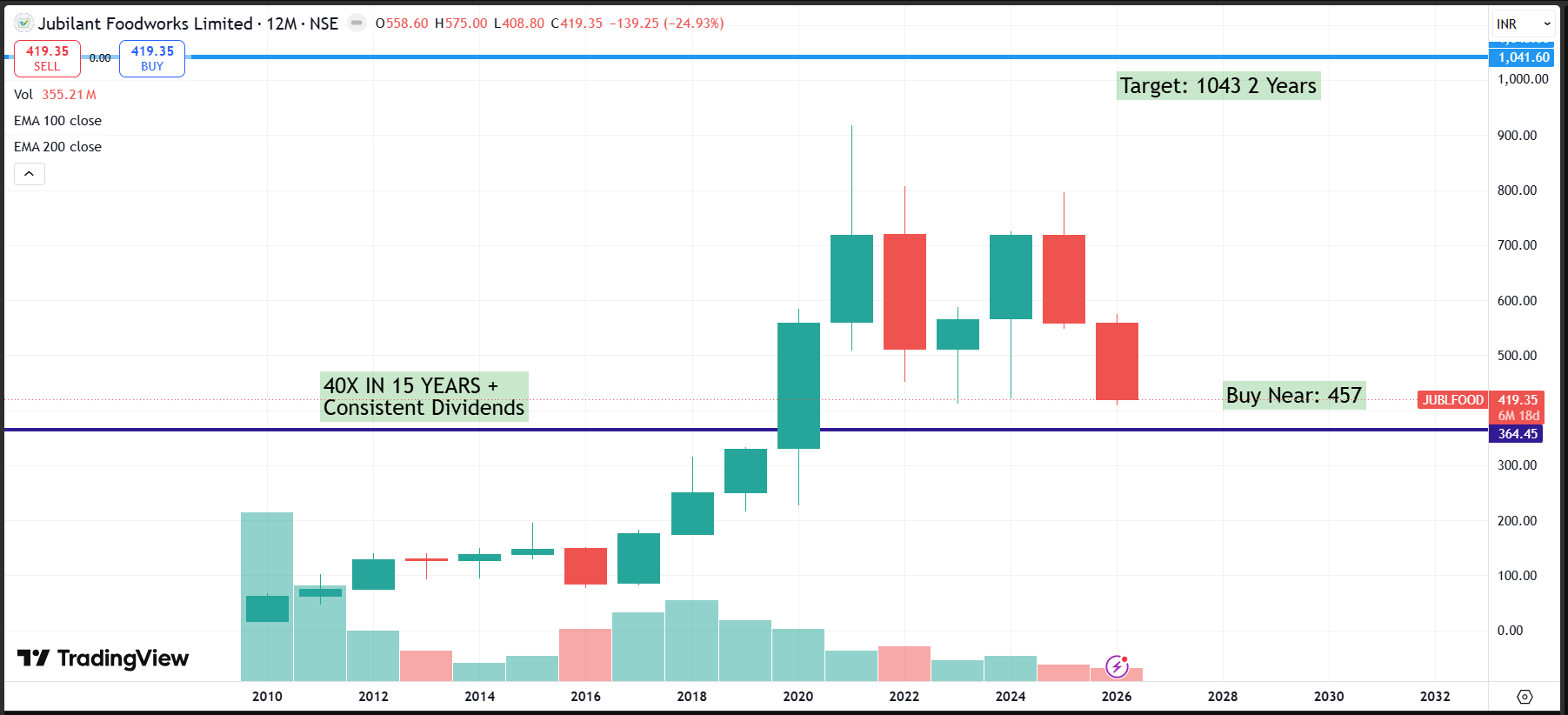
The Tactical Play (Short-Term): Range-bound. Near-term fuel and labor cost inflation will limit sudden upside. Buy selectively during market corrections below the $\text{INR } 420$ mark, utilizing a SIP-staggered approach.
Fairvalue:
Mandatory Disclosure
This report is for educational and informational purposes only. It does not constitute personal financial advice. Investors should consult with certified financial advisors and conduct their own due diligence before deploying capital into equity markets. Figures are sourced directly from Jubilant FoodWorks Ltd's Q4 FY26 statutory filings and official investor presentations.
$$\text{Free Cash Flow to Firm (FCFF)} = \text{Cash Flow from Operations} - \text{Net Capex on cash basis}$$