Avenue Supermarts Ltd (DMART) Q1 FY27 Analysis: Resilient Tier-2 Expansion vs. Metro Store Stagnation
By the ProfitFromIt Corporate Investment Advisory Team
When analyzing brick-and-mortar retail, true operational strength is tested not just by how fast a company can open new doors, but by how much revenue it can squeeze out of its existing ones. In Q1 FY27, Avenue Supermarts (DMART) presented a classic tale of two markets: robust growth in non-metros masking a sudden plateau in their highest-grossing urban stores.
Here is our elite equity research breakdown of DMart’s latest quarterly print and what it means for your portfolio.
The Snapshot
Note: All financial figures analyzed below are on a consolidated basis.
The 'Wow' Factor
Topline Resilience: Consolidated revenue crossed the ₹18,000 Cr mark, registering a solid 14.9% YoY growth.
E-Commerce Discipline: In a surprising but financially sound move, management shuttered DMart Ready operations in 7 underperforming cities, shrinking the footprint to 11 cities to protect margins.
The Urban Plateau: Stores older than 24 months saw Like-for-Like (LFL) growth drop to 5.5%, down from 7.1% a year ago, driven primarily by flat growth in high-revenue large metro stores.
Operational KPI Table
To understand a retailer's health, we look beyond the balance sheet and straight into the aisles.
Financial Deep Dive
Cost vs. Efficiency Analysis:
DMart remains the gold standard in Indian retail for operational frugality. Despite inflationary pressures, the consolidated EBITDA margins expanded slightly:
EBITDA Margin ={1,499}/{18,795} * 100 = 8.0%
This compares favorably to the 7.9% margin in Q1 FY26. Employee benefits and other expenses were kept strictly in line with revenue growth. Furthermore, the decision to raise ₹1,000 Cr via Non-Convertible Debentures (NCDs) indicates a strategic move to lock in capital for store expansion while maintaining an incredibly low Debt-to-Equity ratio of just 0.11x.
Management Integrity and Tone
Verdict: Highly Transparent and Confident.
Management, led by CEO Anshul Asawa, demonstrated excellent integrity by directly addressing the elephant in the room: flat growth in their older, highly profitable metro stores. There were no excuses—just clear facts. Furthermore, the aggressive cut of DMart Ready in 7 cities shows a management team that is not afraid to kill vanity projects if they do not meet strict Return on Capital Employed (ROCE) thresholds.
Key Risks and Red Flags
Metro Saturation: The flatline in older metro stores is a significant red flag. These stores historically carry the highest revenue per square foot. If Quick Commerce (Q-commerce) players are eating into their urban grocery market share, DMart will need to pivot its urban strategy.
Slowing LFL Growth: A drop in LFL growth to 5.5% limits operating leverage. Retailers rely on high LFL growth to outpace fixed cost inflation.
Peer Benchmarking
When compared to its closest competitor, Reliance Retail (Smart Bazaar), DMart continues to win on EBITDA margins and inventory turnover (currently at a highly efficient 2.66x per quarter). However, competitors like Trent (Star Bazaar) are aggressively expanding their footprint with smaller store formats that might be better suited for dense urban centers where DMart is currently seeing a plateau.
Shareholding & Board Updates
Promoter Reclassification: Mr. Vijay Shankar Chandak has sought reclassification from the Promoter Group to the Public category. This is a routine adjustment and does not signal any fundamental shift in core promoter confidence.
Leadership Shuffle: The appointment of Lalit Ahuja (formerly of Zydus, Apple, FMCG giants) as the new Chief Operating Officer brings fresh, aggressive FMCG-led leadership to the operational helm.
The Forward Curve
Looking ahead to Q2 and Q3 FY27, we project a steady revenue growth baseline of 13% - 15%. The festive season in Q3 will be the true litmus test for whether the metro store stagnation is structural (due to Q-commerce competition) or merely a temporary cyclical blip. We expect store additions to accelerate toward the back half of the year.
Valuation Guardrails
Using the Trailing Twelve Months (TTM) EPS of roughly ₹47, DMart is currently trading at a P/E multiple of:
P/E = 4083/47 approx 86.9x
Verdict: Trading at a Premium.
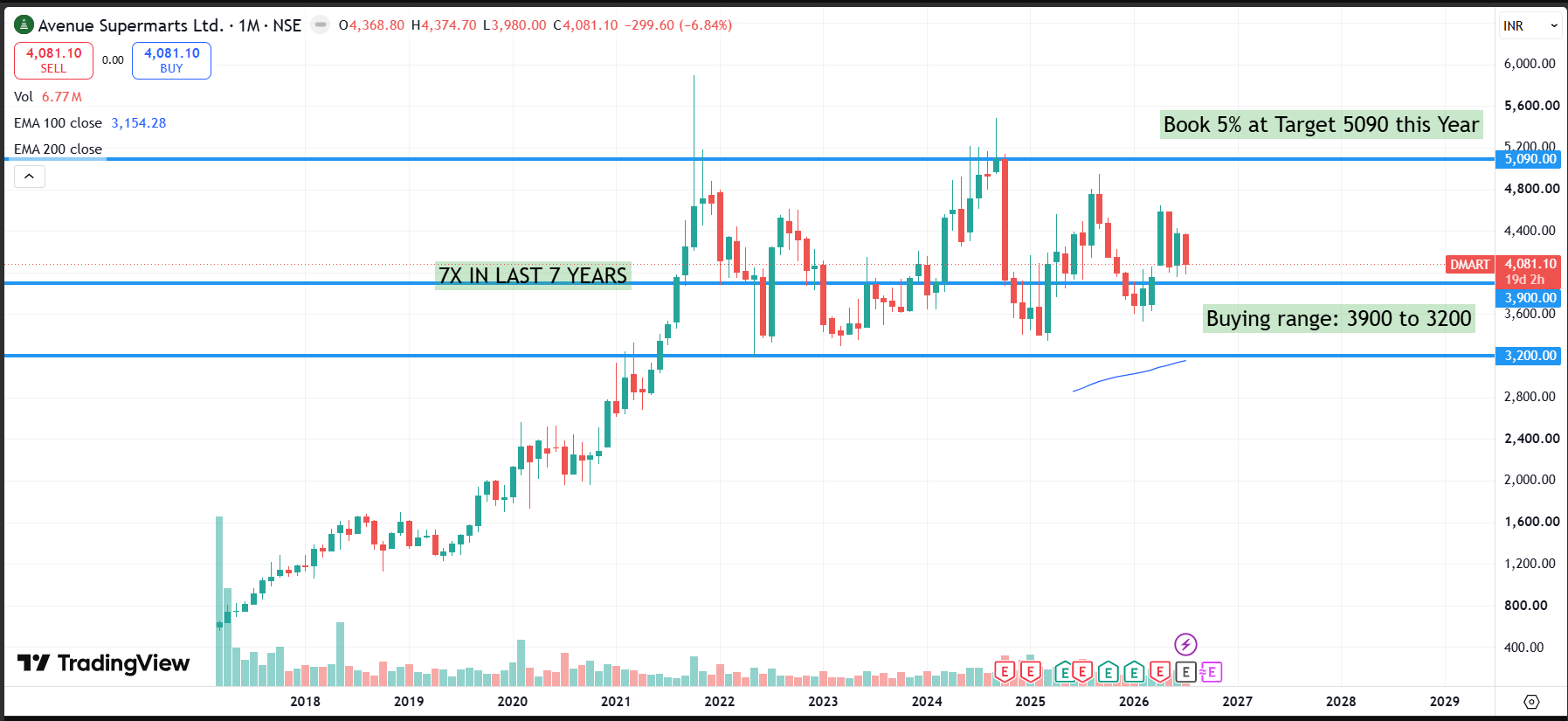
While DMart historically commands a scarcity premium due to its immaculate balance sheet and high ROCE, an 86x multiple leaves absolutely zero room for error. A 5.5% LFL growth rate does not justify further multiple expansion.
The Advisory Note
Strategic (Long-Term) Thesis: DMart remains a compounding machine for patient capital. Their pivot to Tier-2 and Tier-3 cities, where unorganized retail still dominates, provides a runway for the next decade.
Tactical (Short-Term) Price Opportunity: Given the stretched valuations and the sluggishness in urban markets, we do not see an immediate margin of safety at the CMP of 4083. We advise clients to hold existing positions but wait for a broader market correction—ideally bringing the P/E closer to its 5-year lower bound—before initiating fresh accumulation.
Financial Disclosure: This report is for educational and informational purposes only and does not constitute personalized investment advice.