ICICI Lombard Q1 FY27 Analysis: Robust Top-line Meets Temporary Margin Squeeze
By ProfitFromIt Equity Research Desk
Welcome to our exclusive breakdown of ICICI Lombard General Insurance Co. Ltd.'s Q1 FY2027 performance. In this edition, we dissect the numbers to separate structural growth from short-term noise. We aim to decode the narrative behind the numbers, examining the balance between a surging top-line and a profit miss driven by exceptional reserving.
As always, we analyze these numbers through a strict 'Margin of Safety' lens, maintaining a critical view of costs even amidst aggressive growth.
The Snapshot
(Note: Data is on a consolidated basis)
The 'Wow' Factor
Retail Health Boom: The Retail Health segment (part of Individual Health) surged by a staggering 69.5%, significantly outpacing the industry average of 31.6%. Even more impressive, 96.4% of this fresh business came from higher sum assured policies ( ₹10L).
Digital Dominance: A near-perfect 99.7% of policies were issued electronically, demonstrating an incredibly lean, tech-driven acquisition engine. The IL TakeCare app has now surpassed 22.1 million downloads.
Motor Segment Outperformance: While the industry grew at 13.9%, ICICI Lombard outpaced it slightly with 14.0% growth, securing its industry-leading position with a 10.5% market share.
Operational KPI Table
(Note: Adjusted CoR, excluding exceptional items, stood at a much healthier 102.3%. Adjusted RoAE stood at 13.6%.)
Financial Deep Dive: Transient Shocks Mask Core Strength
Below is the consolidated financial performance comparison (Figures in ₹ Billions).
*QoQ figures derived from preceding quarter trends.
Cost vs. Efficiency Analysis:
The headline grabber this quarter is the sharp 46% decline in Profit After Tax (PAT). However, our deep dive reveals this is not an operational failure but a result of prudent, arguably aggressive, reserving.
The Honorable Supreme Court's recent judgment altered the calculation for compensation in Motor Third-Party (TP) claims, specifically valuing unpaid domestic work. In response, ICICI Lombard immediately booked an additional claim reserve of ₹1.65 billion. This single action spiked the Combined Ratio (CoR) by 2.8%. Furthermore, two unusually large losses in the Fire segment added another ₹0.63 billion, pushing the CoR up by another 1.0%.
If we apply the fundamental insurance formula:
CoR ={Net Incurred Claims}{Net Earned Premium} +{Management Expenses}{Net Written Premium}
Excluding these exogenous shocks, the adjusted $CoR$ stands at an impressive 102.3%, slightly better than the 102.2% reported in the same quarter last year. The underlying underwriting discipline remains intact, but the Fire segment's competitive pricing pressure requires close monitoring.
Management Integrity and Tone
Analyzing the earnings call transcripts, management's tone can be characterized as Transparent and Prudent. There was no attempt to deflect the poor headline numbers. Instead, they leaned into their conservative reserving philosophy. By taking the full ₹1.65 billion hit immediately rather than amortizing it, they prioritized balance sheet integrity over quarterly optics. This proactive stance builds significant trust with institutional investors.
Peer Benchmarking
In the Health segment, ICICI Lombard's 69.5% retail growth aggressively outpaces standalone health insurers (SAHIs) that are averaging around ~31%. Conversely, in the Fire segment, the company accepted a 32.1% de-growth (worse than the industry's 27.8% drop). This isn't a failure to compete; it's a deliberate choice to walk away from margin-destroying price wars typical of PSU insurers, protecting the 'Margin of Safety'.
Key Risks and Red Flags
Regulatory/Judicial Volatility: The retrospective nature of the Supreme Court ruling highlights the persistent risk in the Motor TP segment. Pricing is heavily regulated, and unexpected claim revaluations can instantly erase margins.
Fire Segment Bloodbath: The commercial property space is experiencing severe pricing pressure due to soft reinsurance renewals. The 32.1% drop in Fire GDPI is a red flag indicating a highly toxic pricing environment.
NATCAT Exposure: The increasing frequency of catastrophic weather events globally remains a wildcard for the entire property and casualty book.
The Forward Curve
Looking ahead to Q2 and Q3 FY2027, we anticipate a normalization of the Combined Ratio as the one-off Motor TP reserves are fully absorbed. We expect the CoR to glide back toward the 102%-103% range. Retail Health will continue to be the primary growth vector, likely sustaining >30% growth as the push toward higher sum assured policies gains traction. The upcoming festive season should also provide a cyclical boost to Motor Own Damage (OD) premiums.
Valuation Guardrails
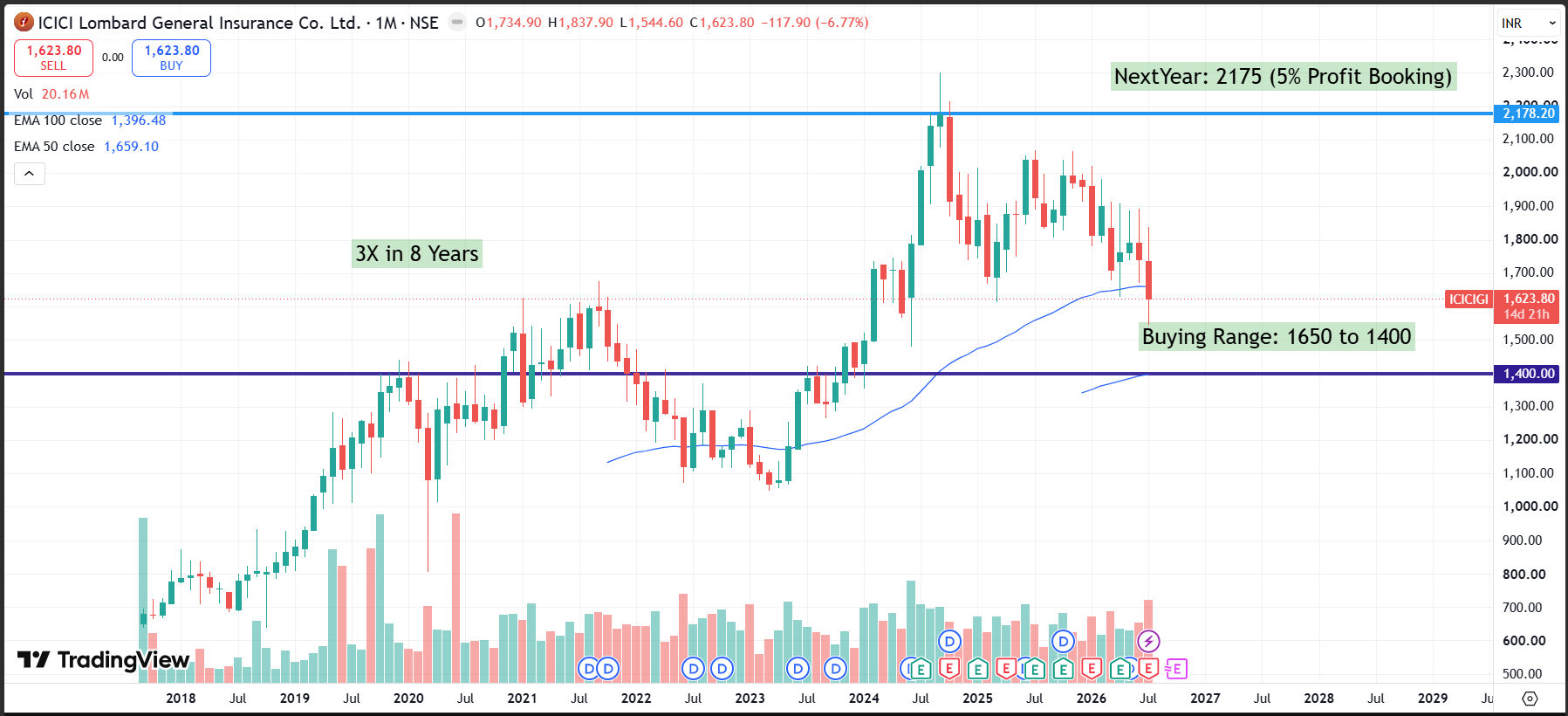
At the current market price of ₹1,623, the stock is reacting to the headline profit miss.
Valuation Stance: Historically Discounted.
The market often punishes short-term reserving adjustments. However, ICICI Lombard's Solvency Ratio of 2.71x (well above the 1.50x requirement) proves the balance sheet is a fortress. Trading below its historical peak multiples, the current price offers a margin of safety for investors willing to look past one quarter of optical weakness.
Shareholding Pattern Note
There have been no significant red flags regarding promoter pledges or mass institutional exits. The stability in DII/FII holding post-results suggests that 'smart money' agrees with the assessment that the profit dip is an accounting adjustment rather than a structural flaw.
The Advisory Note
Strategic Outlook (Long-Term): The core business is thriving. The shift towards higher-margin retail health, combined with relentless digital efficiency and a bulletproof solvency ratio, makes this a robust long-term compounding story.
Tactical Outlook (Short-Term): The stock may experience near-term volatility as retail investors digest the 46% PAT drop. We view this as a 'Buy the Dip' opportunity, accumulating shares while the market misprices prudent reserving as operational failure.
Disclaimer: This analysis is for informational purposes only and does not constitute financial advice.