Nestlé India Q1 FY27 Analysis: Volume-Led Aggression vs. Inflationary Headwinds
At our firm, we continually preach the importance of the 'Margin of Safety'—especially when evaluating high-multiple compounders in the FMCG sector. Nestlé India’s (NSE: NESTLEIND) Q1 FY27 results present a fascinating case study in operational leverage and aggressive brand execution. Despite mixed commodity markets, the company has delivered blisteringly fast volume-led growth, effectively defending its premium valuation.
Here is our elite desk analysis of their consolidated Q1 FY27 performance.
The Snapshot
The 'Wow' Factor
Staggering Topline Growth: Delivered a robust 25.4% YoY sales growth, driven predominantly by underlying volume rather than just price hikes.
Profitability Surge: Profit After Tax (PAT) skyrocketed by 48.2% YoY, showcasing immense operational leverage.
Aggressive Reinvestment: Advertising and marketing spends were ramped up by over 40%, signaling a highly offensive strategy to capture market share while margins remain healthy.
Export Dominance: Clocked a 35.6% growth in exports despite geopolitical headwinds, earning the prestigious 4-Star Export House status.
Operational KPI Table (FMCG Focus)
Financial Deep Dive (Consolidated)
YoY Growth (%) = [(Current Period - Prior Period) / Prior Period] x 100
Cost vs. Efficiency: Nestlé's management executed a masterclass in margin protection this quarter. The cost of materials consumed dropped by roughly 210 basis points (from 45.0% to 42.9% of sales YoY). Instead of letting this entirely pad the bottom line, management strategically diverted these gross margin savings into brand building, spiking ad spends by 40%. Even after this aggressive reinvestment, the EBITDA margin expanded to a highly resilient 24.2%. This proves the company commands exceptional pricing power and procurement efficiency.
Peer Benchmarking
When stacked against FMCG giants like Britannia or HUL, Nestlé is operating in a different gear. While the broader sector is struggling to print mid-single-digit volume growth, Nestlé’s double-digit volume growth across all four of its product categories (Prepared Dishes, Milk Products, Confectionery, Beverages) is a massive anomaly. Their aggressive pivot into Q-Com platforms and rural DMS (Distribution Management Systems) is clearly out-executing the nearest competitors.
Key Risks and Red Flags
Management Tone: Mr. Manish Tiwary’s commentary is highly confident and transparent, focusing heavily on sustainable growth and aggressive reinvestment rather than defensive cost-cutting.
Commodity Inflation: The protein complex (dairy) is facing structural inflationary pressure as demand outpaces supply.
Weather Volatility: Cocoa and sugar remain vulnerable due to El Niño-linked erratic rainfall, potentially squeezing gross margins in the Confectionery group (KitKat) in H2.
Elevated Edible Oils: Prices remain historically high, which could impact the Prepared Dishes (Maggi) segment if further shocks occur.
Shareholding Dynamics
Nestlé's shareholding structure remains a fortress. Promoter holding is rock-solid at 62.76% with exactly 0% pledge, providing a strong 'Margin of Safety' in governance. Over the last year, we have seen minor offloading by FIIs (down to ~9.74%), which has been seamlessly absorbed by DIIs (up to ~12.39%), highlighting deep-rooted domestic institutional faith in the story.
Valuation Guardrails
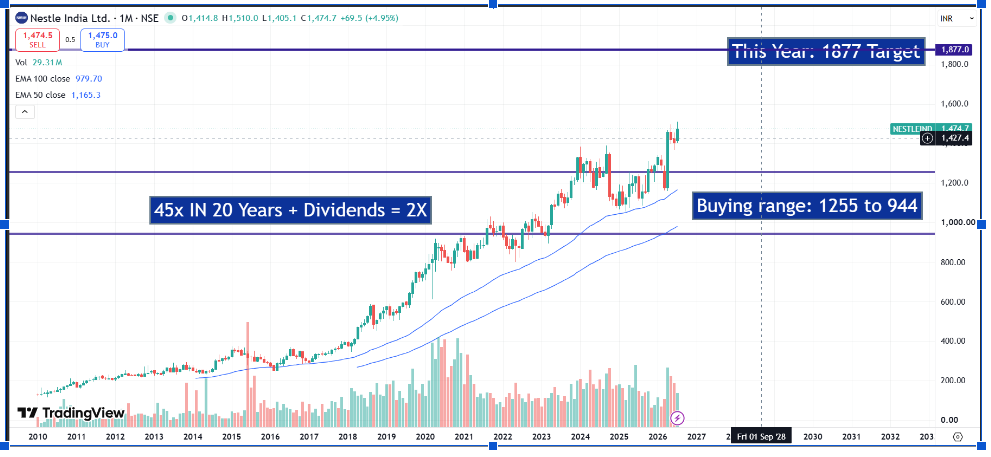
At a CMP of ₹1,472, Nestlé India is trading at a trailing Price-to-Earnings (P/E) ratio of roughly 78x - 80x. Compared to its 5-year median P/E of approximately 65x, the stock is firmly Trading at a Premium. While the premium is justified by the superlative 48% PAT growth and 25% sales growth, any deceleration in Q-Com momentum or a spike in cocoa/dairy prices could trigger a harsh valuation reality check.
The Forward Curve
Based on current guidance and channel checks, we project momentum to remain elevated over the next two quarters. The upcoming festive season, paired with the recent launch of premium SKUs (Nespresso pavilions, Maggi Spicy Green Chilli) and rapid rural penetration, should sustain low-to-mid double-digit revenue growth. However, H2 margins may face slight sequential compression if coffee and cocoa prices spike.
The Advisory Note
Strategic Outlook (Long-Term): Nestlé remains a core portfolio compounder. Their execution in the Out-of-Home (OOH) segment and premiumization vectors makes it a quintessential 'Buy & Hold' asset for generational wealth.
Tactical Outlook (Short-Term): Given the rich 80x multiple, the margin of safety for fresh entry at ₹1,472 is razor-thin. We recommend a "Hold" for existing investors, advising fresh capital deployment only on broader market corrections that bring the P/E closer to its 65x historical median.
Financial Disclosure: This analysis is for educational and informational purposes only and does not constitute registered investment advice. Equity investments are subject to market risks. We, or our firm, hold positions in the stock discussed.